
AI Role-Play Sales Training for Insurance Agents: Ramp Faster
Hunter Correll, Co-founder, ATHOS ·

Your new agents are burning expensive live leads because they can't handle real Medicare Advantage objections without a script. You wait weeks for reps to ramp while paid prospects hang up. Your QA team can only audit a tiny fraction of calls, so CMS violations and missed disclosures slip through undetected. Traditional e-learning modules can't replicate the unpredictability of senior conversations, so you end up hiring based on interview performance instead of proven selling ability.
AI role play sales training for insurance agents replaces static decision trees with unscripted simulations that force reps to master compliance and closing skills before they ever touch a dialer. This doesn't replace human mentorship or guarantee regulatory safety. But it stops the financial bleed of practicing on paid traffic, and it means every rep can handle a senior's curveball objections under pressure.
Why Medicare Agencies Are Replacing Scripted E-Learning With AI Role-Play
Static training modules create a false sense of readiness that evaporates the moment a prospect deviates from the expected path. You need a training environment where mistakes cost practice minutes, not commission dollars and regulatory standing.
The High Cost of Practicing on Paid Leads
Every call a new agent makes to a purchased lead is a gamble with your marketing budget and your carrier relationships. When reps stumble through mandatory disclosures or freeze at common objections, they waste opportunities that cost hundreds of dollars to generate, and they damage your agency's reputation with seniors who feel unheard. AI sales simulation training removes this risk. It gives agents unlimited repetition in a zero-stakes environment where they can fail safely and rebuild their approach until the conversation flows naturally.
Unscripted Senior Personas vs. Static Decision Trees
Medicare beneficiaries don't follow predictable scripts. Yet most insurance agent practice calls rely on rigid branching logic that rewards memorization over comprehension. Unscripted AI personas throw genuine curveballs, interrupt mid-sentence, and change direction based on tone, forcing reps to listen actively rather than recite approved language. This exposes gaps in product knowledge and empathy that multiple-choice quizzes never reveal. You only promote agents who can actually handle the chaos of real enrollment periods.
How Unscripted AI Simulations Replicate Real Medicare Advantage Objections
Generic sales trainers teach persuasion tactics that crumble against specific regulatory constraints and senior skepticism. Your agents need to master Medicare Advantage objection training inside the strict boundaries of CMS guidelines, not just show general sales confidence.
Dynamic Responses to CMS Compliance and Disclosure Gaps
Compliance failures often happen because agents rush through required statements to get back to their pitch, and text-based modules rarely catch this. Voice AI roleplay for agents detects skipped disclosures, incorrect plan details, and Scope of Appointment errors in real time, and stops the simulation until the rep corrects the mistake. This immediate feedback builds muscle memory for CMS compliance gaps that a PDF or a training video simply can't. Regulatory adherence becomes a reflex instead of a checklist item.
Voice AI Roleplay for Natural Conversation Flow
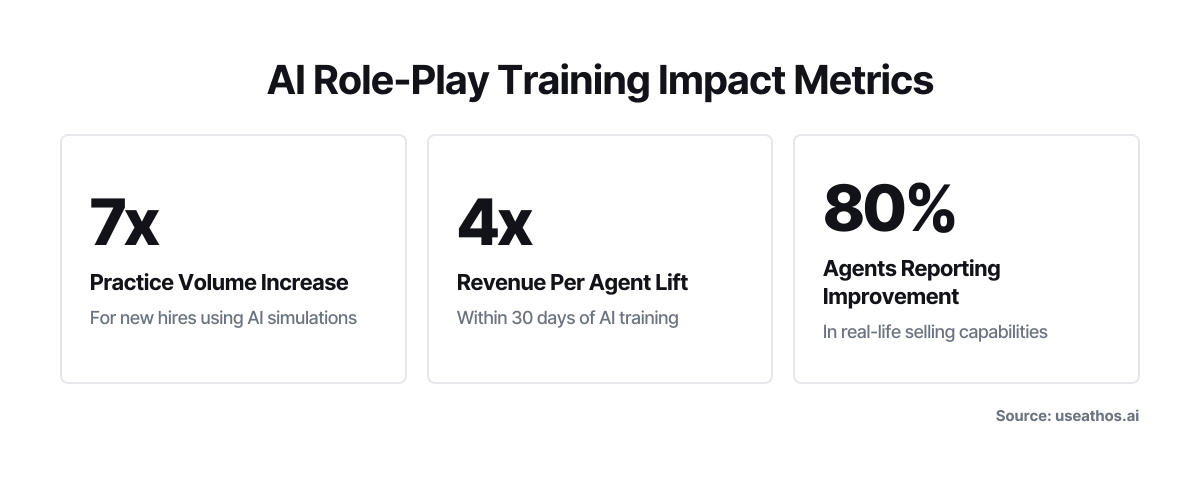
Text-based chatbots let agents edit responses and take pauses that would be fatal on a live call, which builds bad habits that transfer straight to lost revenue. Voice-based simulation forces reps to manage silence, modulate tone, and think while speaking, which mirrors the actual cognitive load of selling to seniors over the phone. According to Second Nature's optimization research, 80% of agents reported an improvement in real-life selling capabilities after implementing AI-driven training, because the medium matches the job they were hired to do.
Measurable Impact: Ramp Time, Close Rates, and Revenue Per Agent
You can't justify training investments based on completion rates or satisfaction scores when your P&L demands faster productivity. AI role play sales training for insurance agents converts abstract learning hours into business outcomes that directly offset acquisition costs.
Accelerating Onboarding Without Adding Headcount
New hires typically spend weeks shadowing top performers or listening to recorded calls before they're cleared to sell. That's a bottleneck that scales poorly during AEP. Per Second Nature's data, practice time grows 7x for new hires and 6x for ongoing training when teams use AI role play simulations, compressing the ramp period without extra management bandwidth. Your team enters peak season with more productive seats and fewer reps still waiting for their first live transfer.
Revenue Lift and Closing Rate Improvements
Faster ramp times matter only if they translate to closed policies and retained commissions. Second Nature reports that clients have tracked a 4x increase in revenue per agent within 30 days of training with AI simulations, which suggests deliberate practice against realistic objections pays for itself quickly. When reps enter live calls having already navigated dozens of similar scenarios, their close rates stabilize faster and their chargeback ratios drop, because they're selling correctly from day one.
Scaling Coaching Cadence Beyond Human Limitations
Your best managers want to coach more, but administrative tasks and firefighting eat the hours they should spend developing talent. Less than 8% of a sales manager's workload goes to coaching, according to RAIN Sales Training, even though top-performing teams are 51% more likely to maintain a regular cadence.
Bridging the Coaching Gap for Sales Managers
AI platforms deliver personalized, objective feedback on every practice session, freeing your leaders to focus on high-value strategy and complex deal support. Instead of reviewing the same basic competency issues over and over, managers can review aggregated performance data to find systemic weaknesses and target interventions where they'll actually move the needle. That consistency matters most on remote teams and night shifts, where human supervision is thin or nonexistent.
Integrating Practice Calls With Live Call Compliance Scoring
Training that doesn't connect to execution is just entertainment that burns payroll. You have to validate that skills practiced in simulation actually show up on live calls, or you're certifying competence that doesn't exist in production.
From Safe Practice to 100% Live Call Auditing
Random sampling misses most compliance risks because violations tend to cluster around specific agents, times, or campaign types rather than spread evenly. Automated live call scoring analyzes 100% of interactions for script deviations, missed disclosures, and tonal issues, giving you complete visibility instead of statistical guesswork. That coverage catches problems before they become chargebacks or regulatory inquiries.
Closing the Loop Between Training and Execution
The gap between what agents learn and what they do shrinks only when practice and performance share the same evaluation criteria. When your AI training platform and live call analytics use identical scoring models, reps get a consistent signal about what excellence looks like, whether they're in simulation or on a real call. That alignment prevents the confusion that comes from classroom rules differing from floor reality.
Evaluating AI Sales Simulation Platforms for Insurance Teams
Not all AI trainers understand Medicare. Generic tools will waste your budget teaching irrelevant skills to specialized agents. You need a platform built for the regulatory and conversational realities of insurance sales, not a repurposed customer service bot.
Vertical Specificity vs. Generic Sales Tools
Medicare Advantage objection training requires deep knowledge of plan structures, enrollment periods, and beneficiary psychology that horizontal sales platforms lack. A vertical-specific solution comes pre-loaded with accurate scenarios, compliant language, and industry-standard KPIs, which cuts out months of configuration and content creation. Generic tools may have a polished interface, but they force you to build the entire insurance context from scratch. That delays ROI and adds accuracy risk your compliance team can't afford.
Screening Candidates Before the Interview
Hiring mistakes are expensive, yet most agencies still rely on resumes and role-plays run by biased interviewers to predict sales success. ATHOS requires candidates to complete a voice-based AI sales simulation before hiring, so managers only interview reps who can already handle Medicare objections. That objective screening filter takes the guesswork out of recruitment, and your onboarding resources go only to candidates who've already shown baseline selling ability against realistic senior personas.
Deploying Your First AI Role-Play Training Sprint
Stop planning a perfect rollout and start fixing your most expensive leak today. Pick one high-friction scenario, like plan comparison handling or SOA confirmation, assign it to your next new hire cohort, and measure their live call performance against the previous group. Review the simulation scores alongside early call audits after two weeks to check the transfer, then expand to additional scenarios once you have proof the practice translates to compliant revenue.
Frequently Asked Questions
How does unscripted AI role-play differ from traditional scripted insurance training modules?
Unscripted AI uses dynamic personas that respond to tone, pacing, and content in real time rather than following predetermined decision trees. This forces agents to listen and adapt instead of memorizing branching paths, exposing gaps in product knowledge and compliance that static modules miss. Traditional e-learning tests recall, while AI simulation tests applied selling ability under realistic pressure.
Can AI role-play effectively train agents on CMS compliance and mandatory disclosures?
Yes, voice-based AI detects skipped disclosures, incorrect plan details, and Scope of Appointment errors during the simulation and stops the session until corrected. This immediate feedback builds muscle memory for regulatory requirements that reading documents or watching videos cannot establish. The system enforces compliance as a conversational habit rather than a theoretical concept.
What specific metrics improve when agencies switch to AI sales simulation training?
Agencies typically see practice volume increase 6-7x, ramp time compress significantly, and revenue per agent rise within the first 30 days. Close rates stabilize faster because reps enter live calls having already navigated dozens of realistic objection scenarios. Chargeback ratios also tend to drop as agents sell correctly from their first day on the phones.
Why is voice-based simulation necessary for insurance sales compared to text-based chatbots?
Insurance sales happen over the phone, so text-based practice allows editing and pauses that would be fatal on live calls. Voice simulation requires managing silence, modulating tone, and thinking while speaking, which mirrors the actual cognitive load of selling to seniors. This medium match ensures skills transfer directly to revenue-generating interactions rather than staying trapped in a chat interface.