
Pre-Hire Sales Assessment for Insurance Agents: AI Tools
Hunter Correll, Co-founder, ATHOS ·

You're burning expensive live leads on new hires who can't close Medicare enrollments. Your current hiring process can't predict who'll fail before they cost you money.
Most agencies rely on resume claims or generic personality inventories. Those measure traits, not the specific ability to navigate CMS regulations and sell over the phone. A valid pre-hire sales assessment for insurance agents has to test actual enrollment conversations, not just theoretical aptitude. The gap between a candidate's interview persona and their live call performance is where your profitability disappears.
This guide breaks down why traditional screening fails in regulated insurance environments, and how voice-based AI simulations identify reps who can actually reach top-tier earnings. You need a screening method that validates objection handling and compliance adherence before you hand over a dialer login. That protects your lead budget and your regulatory standing.
Why Generic Personality Tests Fail Medicare Sales Hiring
Standard psychometric assessments were built for corporate culture fit, not for the high-pressure, regulated world of Medicare Advantage sales, where a single missed disclosure triggers a chargeback. You can't afford to evaluate candidates on self-reported extroversion or conscientiousness when the job requires navigating unscripted senior objections while sticking to strict federal guidelines.
The Cost of Mis-Hires in High-Turnover Call Centers
Every agent who quits within ninety days costs you thousands in wasted recruiting spend, training hours, and burned leads that never converted. High-turnover call centers often fill seats with warm bodies to keep the floor staffed, but that volume-based approach to candidate screening for call centers only speeds up the churn cycle and wears down team morale. Your QA team can only audit a small sample of calls, so the mis-hires you miss early become compliance liabilities that surface months later as regulatory penalties or lost commissions.
Why Self-Reported Traits Don't Predict Enrollment Closers
A candidate can score perfectly on an insurance agent hiring test by picking the answers they know you want, then freeze the moment a senior prospect asks about Part B givebacks or network restrictions. Self-reported traits measure what a person believes about themselves, not how they perform under the cognitive load of a real-time sales conversation with compliance stakes on the line. Resumes list past titles but skip the detail that actually matters: whether those reps closed enrollments, or just processed applications in a low-friction environment.
Personality tests don't simulate pressure. They can't reveal how a candidate recovers from rejection or corrects course after a compliance slip.
Voice-Based AI Simulations vs. Traditional Insurance Agent Hiring Tests
Voice-based hiring assessments swap multiple-choice questions for full enrollment conversations against AI prospects that behave like real seniors, curveball objections and scope-of-appointment boundaries included. This shift from static testing to dynamic simulation is the only way to validate selling skills before you risk live inventory. Reading a script aloud is nothing like managing a two-way negotiation.
How Unscripted AI Role-Play Validates Real Selling Skills
ATHOS AI uses voice-based simulations where candidates navigate unscripted Medicare Advantage objections and compliance requirements before a human interview ever happens. You end up only interviewing reps who've already proven they can handle the call. Unlike scripted role-plays with hiring managers who know the answers, these simulations force candidates to think on their feet and adapt the pitch in real time, with no safety net. You see exactly how they explain plan benefits, handle silence, and hold rapport when the conversation goes off-script. That's the real predictor of field success.
Measuring Objection Handling Before Burning Live Leads
Your paid leads are too valuable to serve as practice material for reps who lack basic objection handling. A sales simulation interview tool shows whether a candidate defaults to arguing, caving, or pivoting effectively when a prospect says "I'm happy with my current plan" or "my doctor isn't in network." Measure that behavior in a simulated environment first, and you protect your marketing ROI while making sure every live lead reaches an agent who's already proven competent.
This approach doesn't guarantee regulatory compliance, and it isn't a substitute for legal counsel. What it does is filter out candidates who lack the baseline conversational skills Medicare sales demands.
Key Metrics: What a Pre-Hire Sales Assessment Must Predict
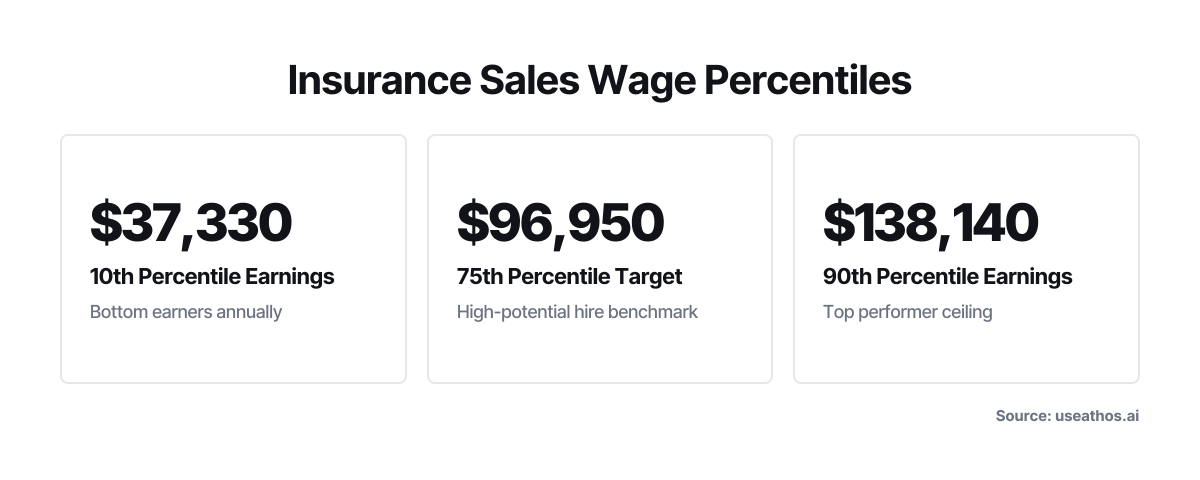
Anchor your assessment strategy to revenue outcomes, not completion rates or subjective interviewer scores. The financial spread between average and elite performers in insurance sales is massive: the 10th percentile earns $37,330 annually while the 90th percentile earns $138,140. Your screening tool needs to identify candidates capable of reaching the upper quartiles, not just candidates who clear the bottom bar.
Correlating Assessment Scores with First-Year Earnings
Top-performing insurance agents at the 75th percentile earn $96,950 a year. That's the value of catching high-potential hires early, through data, not gut feeling. Your pre-hire sales assessment for insurance agents should produce scores that correlate directly with first-year production, so you can set hiring thresholds based on evidence instead of arbitrary cutoffs. When assessment data predicts earnings potential, hiring stops being a cost center and starts compounding as a revenue lever with every successful placement.
Reducing Ramp Time and Early Attrition
Employment for insurance sales agents is projected to grow 3.3% from 2025 to 2035, which keeps the pressure on for efficient screening that shortens time-to-productivity for new cohorts. Candidates who prove proficiency in simulation need less remedial coaching and hit full quota faster, because they walk into training with validated foundational skills already. Early attrition drops when new hires get early wins instead of immediate failure. That builds a cycle where your best recruiters attract better talent, because your retention numbers back up their pitch.
Integrating Candidate Screening for Call Centers into Your Funnel
Insert the AI simulation between resume review and live interviews, so your hiring managers only engage with candidates who've already passed a functional skills gate. This change cuts interview fatigue. Every hour spent in face-to-face evaluation goes to viable prospects, not hopeful applicants who can't actually sell.
- Resume Review: Filter for minimum licensing and tenure requirements.
- AI Simulation: Candidates complete a 15-minute voice-based enrollment scenario asynchronously.
- Score Review: Managers review simulation results and compliance flags before scheduling.
- Live Interview: Focus exclusively on cultural fit and career goals, skipping basic skills validation.
You stop asking candidates to describe their sales process and start watching them execute it. That compresses your hiring cycle and sharpens forecast accuracy for staffing needs. This integration works alongside existing ATS platforms without a technical overhaul, so operations teams already managing high-volume recruitment can adopt it without friction.
Beyond the Hire: Connecting Assessment Data to Onboarding
Pre-hire assessment data is worthless if it dies in the HR folder. It has to flow directly into your training curriculum to personalize development and speed up ramp. Hunter Correll and Jason Paradise founded ATHOS as Medicare agency owners, to solve their own hiring and ramp inefficiencies, not to build generic HR software. That's why the platform connects screening results to ongoing skill development.
Using Simulation Gaps to Personalize New Agent Training
When a candidate clears the hiring threshold but shows weakness explaining supplemental benefits or handling pricing objections, your LMS should automatically assign modules targeting those specific gaps. That kills the one-size-fits-all bootcamp, the one that bores your strong hires while leaving the weak ones behind, and replaces it with precision coaching that respects individual learning curves. New reps practice their specific weak spots against AI before they ever touch a live call, which shortens the window between hire date and first sale.
Continuous Compliance Scoring from Day One
The same scoring criteria used in pre-hire assessment should apply to live calls through post-hire call scoring and QA systems, so selection and performance management share one continuous standard. When agents see compliance measured the same way from simulation through production, they internalize the standard faster and treat regulatory adherence as part of selling, not separate from it. That alignment cuts the dissonance that makes new hires abandon training protocols the moment they feel pressure to produce.
Evaluating Sales Simulation Interview Tools for Regulatory Compliance
In Medicare sales, a rep who closes aggressively but misses mandatory disclosures creates more liability than value. Your assessment tool needs to score compliance behaviors with the same rigor as sales technique. Effective screening checks Scope of Appointment adherence, TPMBA timing rules, and required disclaimer delivery inside the simulation itself, not as an afterthought. You need visibility into CMS compliance risks during hiring, because catching a violation pattern before employment begins is far cheaper than defending a chargeback or audit finding later.
Regulatory knowledge tested in isolation doesn't predict whether a rep executes correctly under sales pressure. That's why integrated behavioral measurement beats a multiple-choice compliance quiz every time. Tools that measure sales aggression without compliance guardrails optimize for the wrong outcome, and that exposes your agency to risk you could have avoided.
Future-Proofing Insurance Agent Recruitment in 2026
Agencies scaling in 2026 face a labor market where speed and precision decide whether growth targets turn into sustainable profit or expensive turnover. AI-native hiring stacks are becoming table stakes, because manual screening can't keep pace with volume demands while holding the line on quality in a regulated environment. Employment growth keeps rising, so efficient screening is what lets you maintain quality without bloating headcount or loosening compliance.
Adopt voice-based AI sales simulation capabilities now, and your operation can absorb market expansion without a proportional jump in hiring overhead or regulatory exposure. The agencies that treat pre-hire assessment as a revenue function, not an HR checkbox, will take the bigger share as Medicare sales keeps changing.
Frequently Asked Questions
How does a voice-based AI simulation differ from standard personality tests for insurance agents?
Voice-based simulations require candidates to conduct actual enrollment conversations with AI prospects that throw unscripted objections and test compliance knowledge in real time. Standard personality tests only measure self-reported traits like extroversion or conscientiousness through multiple-choice questions that candidates can game. Simulations predict job performance by observing behavior under pressure, while personality inventories measure theoretical preferences that rarely correlate with closing ability in regulated sales.
What specific behaviors should a pre-hire assessment validate for Medicare agents?
Assessments must validate objection handling, Scope of Appointment adherence, mandatory disclosure delivery, and the ability to explain complex plan benefits conversationally. These behaviors directly impact both revenue and regulatory compliance in Medicare Advantage sales. Tools that only measure general sales aggression without scoring compliance execution create liability rather than predictive value.
Can pre-hire assessments accurately predict top-tier earnings in insurance sales?
Validated voice-based assessments correlate with first-year earnings because they measure the specific skills that drive enrollment conversions and retention. The wage gap between the 10th and 90th percentile exceeds $100,000 annually, making precise screening economically significant. However, prediction accuracy depends entirely on whether the assessment replicates actual job tasks rather than measuring abstract traits.
How do I integrate AI screening into existing call center hiring workflows?
Place the AI simulation between resume review and live interviews so managers only interview candidates who have passed functional skills validation. This asynchronous step takes 15 minutes per candidate and eliminates basic skills testing from live interview time. Integration typically requires no ATS overhaul and compresses hiring cycles while improving forecast accuracy for staffing needs.