
Reduce Agent Ramp Time in Medicare Advantage Sales
Hunter Correll, Co-founder, ATHOS ·

Every week a new Medicare Advantage agent sits in training instead of closing enrollments, your agency loses revenue that never comes back. You pay for leads they burn, manager hours spent shadowing calls that don't convert, and compliance gaps that surface months later as chargebacks. The industry treats this drag as normal. It isn't sustainable when margins tighten and CMS scrutiny intensifies.
Reducing agent ramp time in Medicare Advantage isn't about rushing unprepared reps onto the phones. It's about replacing passive observation with measurable skill verification before a single live senior interaction happens. Agencies that make this shift stop guessing when someone is ready and start proving it with data.
The True Cost of Slow Agent Ramp in Medicare Advantage
Delayed productivity hits your P&L long before the first commission check arrives. Initial enrollment commissions average over $623 per plan in states like Alabama and Arkansas, making every week of ramp delay a direct revenue loss. That figure compounds across every open seat on your floor during AEP.
Commission Leakage During Onboarding
You bleed margin every day a rep stays in training mode. Commission rates vary a lot by geography: New Jersey pays $780 per initial enrollment while Puerto Rico pays $428, which means ramp efficiency has to be tuned state by state to protect profitability. When your onboarding timeline stretches six weeks instead of three, you forfeit half a selling season's worth of income per agent.
This leakage extends beyond the individual rep. Your top producers spend hours mentoring instead of selling, and that drags down team-wide output right when volume peaks. The opportunity cost of slow onboarding often exceeds the direct training expense.
Retention Risk in the First 90 Days
New agents who struggle early rarely recover confidence or competence. The first 90 days after enrollment are make-or-break for member satisfaction and long-term retention, so agents need to be fully competent the moment they go live. Members who hit confusion or errors during onboarding disenroll at higher rates. That triggers clawbacks that erase whatever commission you eventually paid.
Slow ramp also drives agent attrition. Reps who feel unsupported or unprepared quit before they become profitable, forcing you to restart the expensive hiring cycle. Accelerating competency protects both member relationships and staff stability.
Why Traditional Shadowing Fails Modern MA Teams
Watching experienced reps handle calls does not build selling skills. Shadowing creates an illusion of learning while leaving new hires unable to navigate objections independently once they finally take the headset. Medicare Advantage plans are shrinking their footprints to protect margin, which concentrates enrollment workload and demands faster agent proficiency despite the smaller market.
Passive Learning vs. Active Skill Building
Observation lacks the repetition it takes to internalize complex product knowledge and objection handling. Your new agents hear perfect pitches from veterans but never practice recovering from the awkward silences and hostile questions that define real sales conversations. Muscle memory forms through doing, not watching.
Active skill building requires safe failure. Reps need to stumble through disclosures, misstate benefits, and fumble closings somewhere mistakes cost nothing but feedback. Shadowing denies them that rehearsal space.
Compliance Gaps in Observation-Only Training
CMS regulations demand precise language that passive listening rarely reinforces. New agents may hear correct disclosures during shadow sessions but can't reliably reproduce them under pressure without structured practice. Miss a required statement on a live call, and you've created regulatory exposure that no amount of post-hoc auditing can fully undo.
Compliance failures hide in plain sight during observation. A mentor might gloss over a nuance or use shorthand that technically violates guidelines, and the trainee absorbs the error as standard procedure. Only active simulation with immediate correction catches these deviations before they reach seniors.
AI Practice Calls Before Live Leads: The New Ramp Standard
Burning paid leads on untrained reps is a luxury modern agencies cannot afford. AI simulations give new agents unlimited practice against realistic senior objections, with no financial consequence for getting it wrong. This turns ramp from a time-based milestone into a competency-based gate.
Simulating Real Senior Objections Safely
Voice-based AI prospects throw genuine Medicare Advantage curveballs that scripted roleplays miss. Your reps encounter hearing difficulties, cognitive resistance, spouse interruptions, and benefit confusion in conversations that adapt dynamically instead of following predictable paths. An AI sales simulation platform makes this level of realism possible at scale, without needing senior staff to sit in on every session.
Safe practice builds confidence faster than cautious live exposure. Reps who have already worked through twenty difficult AI conversations walk into their first real call with pattern recognition instead of panic. They recognize objection types and deploy tested responses instead of freezing or overpromising.
Measuring Readiness With Objective Scores
Subjective manager sign-offs introduce bias and inconsistency into ramp decisions. Automated call scoring checks disclosure accuracy, script adherence, tone, and pacing against defined benchmarks on every single practice session. You see exactly where each rep stands relative to production standards before you ever let them near a live call.
Objective metrics replace gut feelings about readiness. Instead of asking whether someone seems prepared, you review quantified performance data showing specific strengths and gaps. This eliminates premature promotions and catches coaching needs early.
Accelerating New Agent Onboarding for Medicare With Voice AI
Speed without quality creates compliance disasters and burned leads. Voice AI speeds up onboarding two ways: it filters candidates before you invest in them, and it gives instant corrective feedback during practice. That combination compresses timelines while raising baseline competency.
Screening for Sales Aptitude Before Hiring
Most agencies discover poor sales aptitude weeks into onboarding. Pre-hire voice simulations identify candidates who can actually sell versus those who merely interview well, so you stop wasting training resources on people unlikely to perform. You only extend offers to people who show baseline persuasion skills against AI prospects.
Screening also calibrates expectations. Candidates who struggle in simulation understand the job's demands before they accept the offer, which cuts early attrition from mismatched assumptions. Those who excel arrive with validated confidence rather than imposter syndrome.
Automating Compliance Checks During Practice
Manual QA cannot cover every practice conversation. Integrated compliance monitoring flags missed disclosures, prohibited statements, and script deviations instantly during AI sessions, so reps self-correct before bad habits form. This continuous feedback loop replaces sporadic coach reviews that catch errors too late.
Automation scales oversight without adding headcount. Your trainers focus on high-value coaching instead of repetitive checklist verification. Every practice call gets the same rigorous compliance evaluation, regardless of staff availability or time of day.
Benchmarking Speed to Productivity Against Industry Norms
Traditional Medicare Advantage onboarding typically spans four to eight weeks before reps hit consistent production. Agencies running AI-first ramp strategies report cutting this timeline substantially by eliminating passive phases and front-loading skill verification. The benchmark shifts from calendar days to demonstrated competency thresholds.
Accelerated ramp doesn't mean skipping foundational knowledge. It means delivering that knowledge through active application instead of lecture. Reps absorb product details faster when they have to immediately use them to navigate simulated enrollments.
Your comparison point should be revenue per rep per month during the first quarter, not weeks to first sale. Faster ramp only matters if it produces sustainable production without elevated chargeback rates. Measure both velocity and quality to confirm the acceleration is real.
Scaling Training Without Adding Headcount
Growth bottlenecks show up when senior mentors become scarce. AI-enabled training decouples onboarding capacity from experienced staff availability, so you can scale teams without hiring trainers in lockstep. That operational leverage matters most during AEP surges and geographic expansion.
Consistent Coaching Across Remote Teams
Distributed teams suffer from uneven training quality when coaching depends on local managers. Voice AI delivers identical practice experiences and feedback standards regardless of location, so remote reps meet the same bar as headquarters staff. Geography stops creating performance variance.
Consistency also aids compliance defense. Regulators expect uniform training standards across all selling locations, and documented AI practice records give you auditable proof of standardized preparation. Remote work arrangements no longer create regulatory blind spots.
Reducing Manager Burden During AEP
Peak season demands maximum selling time from your best people. Offload foundational skill development to AI, and senior agents are freed up to focus on complex cases and closing support instead of basic objection drills. Your mentors step in strategically instead of repeating themselves all day.
Manager bandwidth expands without burnout. Trainers review aggregated performance dashboards instead of sitting through dozens of identical practice calls, which lets them spot systemic issues and target coaching efficiently. Scale stops requiring a linear increase in staff.
Implementing an AI-First Ramp Strategy
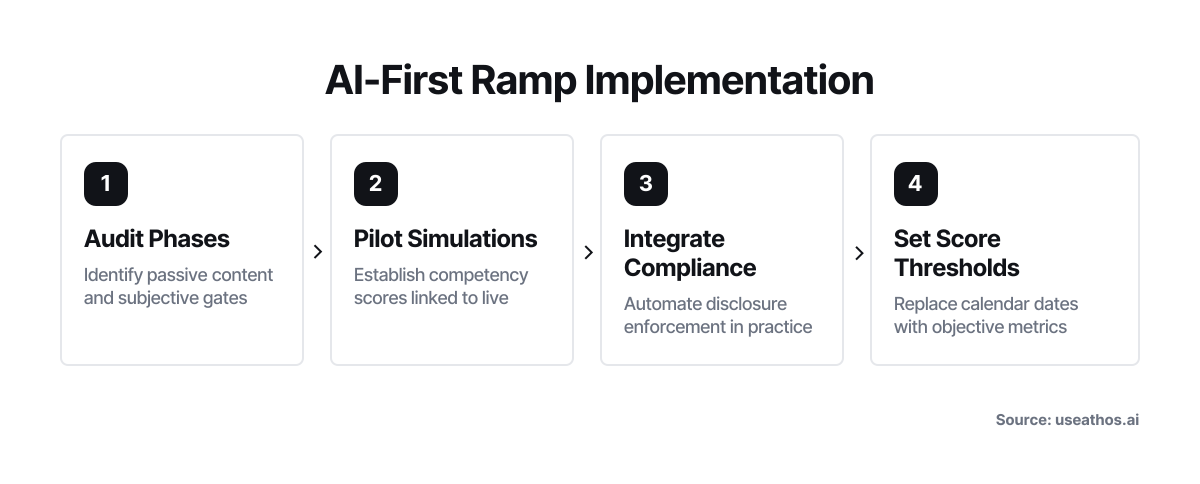
Moving off traditional onboarding takes deliberate process redesign. Start by auditing your current ramp timeline to find the passive phases that could convert to active practice. Map existing compliance checkpoints to see where automated scoring could replace manual review.
- Audit current onboarding phases for passive content delivery and subjective readiness gates.
- Pilot AI simulations with a small cohort to establish baseline competency scores correlated with live success.
- Build CMS compliance automation into practice workflows to enforce disclosure standards continuously.
- Replace calendar-based promotion criteria with objective performance thresholds verified through automated call scoring.
Pilot results inform full rollout parameters. Track conversion rates, compliance incidents, and ramp duration for AI-trained cohorts against traditional groups to quantify impact. Use that data to refine scoring models and adjust readiness thresholds based on actual production outcomes.
AI-first ramp isn't a technology purchase. It's an operational transformation. Success depends on lining up hiring, training, and QA around measurable competency instead of time served.
Frequently Asked Questions
How quickly can new agents start taking live calls with AI practice?
Agents typically reach live-readiness in two to three weeks when AI simulations replace passive shadowing phases. Readiness depends on hitting objective competency scores rather than serving calendar time. Your specific timeline varies based on prior experience and daily practice volume.
Does AI practice actually improve CMS compliance compared to traditional training?
Yes, because every practice session receives instant compliance feedback rather than sporadic manual review. Reps self-correct missed disclosures and script deviations before forming bad habits. Continuous automated monitoring catches nuances that observation-only training misses.
What metrics should I track to measure ramp improvement?
Track revenue per rep per month during the first 90 days alongside compliance incident rates and chargeback frequency. Compare these figures between AI-trained and traditionally trained cohorts to isolate impact. Avoid using weeks-to-first-sale alone, as speed without quality creates downstream losses.
Can AI screening predict which candidates will succeed in Medicare sales?
Voice-based pre-hire simulations identify baseline persuasion skills and objection handling ability that resumes and interviews miss. Candidates who perform well in simulation consistently show faster ramp and higher early production. Screening reduces wasted onboarding investment on unlikely performers but does not guarantee individual success.