
Stop Burning Leads on New Insurance Agents in 2026
Hunter Correll, Co-founder, ATHOS ·

Every unready agent you put on the phones drains your marketing budget. You pay a premium for exclusive Medicare Advantage leads, then traditional onboarding has new hires learn by burning that inventory during their first weeks. Novices can't close at the rate tenured reps do, and the damage goes well past the initial cost per lead.
Stopping this bleed means changing how you validate readiness before a rep ever touches live inventory. Figuring out how to stop burning leads on new insurance agents means replacing hope-based ramp periods with verified competency checkpoints that protect your margins from day one.
The True Cost of New Agent Lead Waste
Most agencies track cost per acquisition but ignore the gap in conversion rates between new and experienced reps during the first ninety days. Assign live prospects to unproven talent and you're paying a premium for lower performance, while your regulatory exposure goes up at the same time.
Calculating Burned Leads Insurance Sales Losses
The math behind burned leads in insurance sales is more than upfront media spend. Factor in the opportunity cost of a lead a closer could have worked, plus the chargebacks and compliance penalties that show up when inexperienced reps mishandle sensitive enrollments.
Agencies typically lose real revenue during traditional ramp periods, because new agents convert at a fraction of what established producers do while working the same volume of fresh inquiries. That gap is pure margin erosion, and it compounds with every hiring class you bring on.
Why Traditional Ramp-Up Models Fail in 2026
Shadowing and classroom lectures don't prepare reps for the speed and scrutiny of modern Medicare sales. Today's regulatory environment demands precision immediately. Seniors expect knowledgeable guidance the moment they pick up the phone, not patience while a novice finds their footing.
Your current onboarding process probably assumes exposure equals competence. Passive observation doesn't build the muscle memory reps need to handle objections under pressure. Using live calls as the primary training ground is a liability, and it exposes your agency to financial and reputational harm you don't need.
Screening for Sales Readiness Before Hiring
You can't protect your lead budget if you hire candidates who can't sell in the first place. Validating actual performance before you extend an offer is the only reliable way to keep confident-but-incompetent reps from eating your training resources without generating revenue.
Voice-Based AI Simulations vs. Standard Interviews
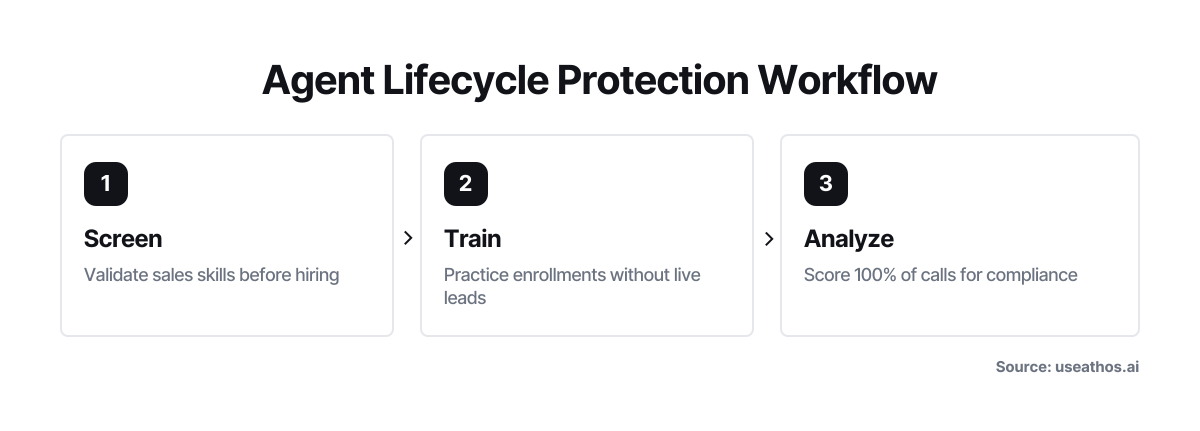
Standard interviews measure communication skills and likability. They don't predict whether a candidate can actually navigate a Medicare enrollment conversation. Candidates complete a voice-based AI sales simulation before being hired, so managers only spend interview time on reps who have already shown they can sell, not just talk about selling.
This step filters out candidates who sound polished in a structured Q&A but crumble against unscripted resistance from a senior prospect. You're testing real-world application instead of theoretical knowledge, so every person you onboard starts with a baseline probability of success.
Identifying Coachable Traits Early
Screening isn't just about rejecting poor performers. It's also about spotting which candidates have the traits that make coaching work. Watch how a candidate responds to correction inside the simulation, and you'll see whether they adapt quickly or will need heavy management once they're live.
Candidates who show resilience and adaptability in a simulated environment are far more likely to protect your lead investment during ramp. That data lets you focus limited training bandwidth on hires who show real potential for retention and production.
Implementing Safe Training Environments
The most effective way to stop burning leads on new insurance agents is to remove live prospects from the early learning phase entirely. You need a space where mistakes are educational instead of expensive, where reps can fail safely before they ever touch your bottom line.
Practice-Before-Live-Calls Workflow
New agents practice full enrollments against unscripted AI senior prospects that throw real Medicare Advantage objections. They can repeat the scenario as many times as they need without spending a paid lead or risking a CMS violation. This turns the ramp period from a costly gamble into a predictable skill-building phase, where reps earn their way onto the phones by demonstrating proficiency first.
Repetition builds confidence and competence faster than sporadic live opportunities ever could. Your team gets hundreds of touches on hard scenarios in a compressed timeframe, so by the time they take a live call, they're operating with the fluency of a veteran instead of the hesitation of a rookie.
This directly addresses new agent lead waste by decoupling skill acquisition from revenue-generating inventory. You stop subsidizing education with marketing dollars and start treating training as its own measurable function.
Automating Compliance to Prevent Chargebacks
Random sampling isn't enough to catch the specific errors that trigger chargebacks and regulatory action. You need visibility into every interaction, so your push for productivity doesn't quietly create compliance liabilities that wipe out your profits.
Scoring 100% of Calls for CMS Gaps
Automated QA now covers 100% of dialer calls for compliance gaps, missed disclosures, and script deviations. That closes the blind spots random sampling left open, the ones that historically let chargeback-triggering errors slip through. You catch systemic issues immediately instead of finding them months later during a carrier audit or CMS review.
Full coverage turns compliance from a reactive punishment mechanism into a proactive coaching tool. You can spot trends across your whole floor and fix them before they become widespread problems that threaten your contracting status.
Catching Missed Disclosures Instantly
Speed matters when you're correcting compliance failures, because the window to fix a bad enrollment is narrow. Automated systems flag missing Scope of Appointment forms or disclaimer omissions in near real-time, so supervisors can step in before the error becomes irreversible.
Pairing this with CMS compliance software for Medicare agents gives you a safety net that protects both revenue and license. You can prove diligence to carriers and regulators while cutting the administrative load of manual call reviews.
For more on the technology behind this shift, AI call scoring for insurance call centers gives you the technical context to evaluate vendors.
Accelerating Ramp Time Without Risk
Protecting your budget and speeding up revenue aren't opposing goals once you restructure the learning curve. Shortening the path to first sale takes high-volume practice, something live calling can't provide without unacceptable waste.
Days-to-productivity is the metric that actually matters for training effectiveness in a high-turnover industry. When reps enter the live environment with hundreds of simulated enrollments behind them, they convert earlier and stay longer, because they feel competent instead of overwhelmed.
Safe practice environments compress the experience curve by giving reps concentrated exposure to edge cases that might otherwise take months to encounter naturally. That density of learning shortens your non-producing ramp period while improving the quality of the rep you deploy.
Measuring ROI on Agent Development
You can't manage what you don't measure, and proving the value of protected lead spend takes concrete data. Sales leaders need specific KPIs to show that their development program is an asset-protection strategy, not just an HR expense.
Tracking Lead Savings vs. Training Costs
Compare your historical burn rate against current performance under an AI-enabled workflow to quantify the direct savings from reduced new agent lead waste. The gap in conversion efficiency between cohorts trained via simulation and those trained on live leads gives you a clear dollar value for the investment.
Subtract the cost of the platform and additional training hours from those savings, and you get your true net ROI. That shifts the conversation from subjective feelings about rep quality to financial outcomes that resonate with ownership and finance.
Benchmarking Retention and Close Rates
Retention improves when new hires feel competent instead of defeated by premature live pressure, and that stability has its own compounding value. Track close rates by tenure cohort to confirm your accelerated ramp is producing durable producers, not reps who flash and burn out after an early success.
High retention lowers your cost per hire and stabilizes your forecasting. These benchmarks are the evidence base for scaling your development program and justifying continued investment in AI-powered screening and training features.
Building a Sustainable Onboarding System
Isolated tools and temporary policy fixes won't solve structural inefficiencies in your agent lifecycle. Stopping lead waste means integrating screening, simulation training, and automated QA into one system that scales with your agency.
ATHOS was founded by Medicare agency owners Hunter Correll and Jason Paradise to fix their own hiring, ramp, and compliance problems, after seeing firsthand how expensive burned leads and slow onboarding eat into margins. The workflow comes out of that practitioner background, not a theoretical best-practices document.
Sustainable onboarding treats agent development as a continuous feedback loop: screening data informs training content, and QA insights refine hiring criteria. That alignment is what separates agencies that consistently profit from new classes from those stuck in turnover and waste.
Frequently Asked Questions
How much revenue do agencies typically lose when new agents burn expensive Medicare leads?
Agencies typically lose significant revenue during traditional ramp periods because new agents convert at a fraction of the rate of established producers while consuming the same volume of fresh inquiries. This loss includes the upfront lead cost, the opportunity cost of a missed sale, and potential chargebacks from compliance errors made by inexperienced reps.
What specific workflow allows new agents to practice safely before touching live prospects?
The practice-before-live-calls workflow has new agents complete full enrollments against unscripted AI senior prospects that throw real Medicare Advantage objections. This allows for unlimited repetition and skill building without consuming a single paid lead or risking a CMS violation during the learning phase.
How does voice-based AI screening differ from standard interviews?
Voice-based AI simulations test actual selling ability by requiring candidates to navigate unscripted objections and complete an enrollment, whereas standard interviews only assess communication skills and resume claims. This ensures managers only interview candidates who have already demonstrated they can handle real sales conversations.
Why is 100% call auditing necessary to prevent CMS compliance chargebacks?
Random sampling misses the majority of compliance errors, allowing costly gaps and missed disclosures to slip through until a carrier audit triggers chargebacks. Automated scoring of 100% of calls catches these issues instantly, enabling immediate remediation and protecting the agency from regulatory penalties and lost commissions.