
AI Agent Coaching Software for Insurance: The 2026 Guide
Hunter Correll, Co-founder, ATHOS ·

You hire a licensed agent. You hand over live leads. Weeks later you learn the agent can't close, skips disclosures, or both.
That's the loop AI agent coaching software for insurance is built to break. It moves practice off your paid leads, and it moves quality checks onto every call instead of a few.
This guide explains what the category does, where it stops, and what to demand before you sign anything.
What AI Agent Coaching Software for Insurance Actually Does
AI agent coaching software trains and scores licensed phone agents across their whole lifecycle: before they're hired, while they ramp, and on every live call afterward. The goal is simple. Reps who can sell and stay compliant get on the phones faster.
You get three jobs in one system:
- Screen candidates with a sales simulation before you interview them.
- Train new hires on realistic calls instead of live leads.
- Analyze live calls for compliance gaps and coaching moments.
That scope matters. A tool that only does one of these is a point solution, not coaching software.
Coaching software vs. agent-assist vs. chatbots
The SERP blends three different products. They solve different problems.
Agent-assist helps a rep during a live interaction. NiCE's real-time agent assist is a good example of the category: it supports reps while the contact is happening. That's useful for prompts and answers in the moment, but it doesn't build the skill. The rep who needs a prompt on every call is still a rep who can't handle the call alone.
Chatbots talk to customers. They deflect, route and answer. They don't develop your agents at all.
Coaching software changes what the agent can do on their own. It builds the skill before the call and reviews the result after it.
Agent-assist helps the rep today, while coaching makes the rep better next month, and if you're fixing ramp time and close rates you need the second one. It's not a replacement for assist tools, and it won't answer customers for you.
Why Manual Coaching Fails Medicare and Insurance Sales Teams
Manual coaching depends on a manager's calendar. Managers are busy, so coaching gets squeezed, and the new hire learns on the job. On your dime.
Burned leads on new hires
Live Medicare leads are expensive. Every one handed to a green agent is a bet that the agent already knows the enrollment flow and can handle a skeptical senior.
Most can't, yet. So you get the same sequence every time:
- The new hire takes live leads in week one.
- They stumble on objections they've never heard.
- The lead is gone, and so is the money you paid for it.
Manager role-play doesn't fix this. Your manager plays a friendly prospect who follows a script, and real seniors don't follow scripts. Practice that's easier than the real call teaches the wrong lesson, and your ramp stretches while you wait for reps to figure it out on live calls.
Sample-based QA leaves gaps
Your QA team can't listen to everything. So they pull a random sample and hope it's representative.
The calls nobody hears are the problem. A missed disclosure, a script deviation or a mistake in the scope of appointment (SOA) can sit in an unreviewed recording for weeks. By the time it surfaces, it has become a chargeback, a lost commission or a regulatory headache.
If you only audit a small slice of calls, you don't know your real error rate. You know the error rate of the slice, and that's a very different number to take into a compliance meeting.
The Three Coaching Layers: Screen, Train, Analyze
ATHOS was founded by Medicare agency owners Hunter Correll and Jason Paradise, who built it to fix their own hiring, ramp and compliance problems. Their answer follows the agent lifecycle in three steps. Each one replaces a guess with evidence, and each step feeds the next.
1. Screen: voice-based sales simulation before hiring
Before: You interview a stack of candidates, trust résumés and gut feel, and find out who can sell after you've paid for training and burned leads.
After: Candidates take a voice-based AI sales simulation before they're hired. You interview only the reps who showed they can sell.
You still make the hiring call. Screening just puts a real performance signal in front of you before you spend interview time, which is where most of the waste starts. The pre-hire sales assessment guide covers how to set that up.
2. Train: practice enrollments against unscripted AI prospects
Before: New agents learn on paid leads, or they rehearse with a manager who goes easy on them.
After: New agents run full enrollments against unscripted AI senior prospects that throw real Medicare Advantage objections. They fail on practice calls, which cost nothing, instead of on leads, which cost real money.
Full enrollments is the key phrase. Practicing a pitch is not the same as practicing the whole call from opening to close. For the training side in depth, read AI role-play sales training for insurance agents.
3. Analyze: score every live call for compliance and coaching moments
Before: QA reviews a random sample. Most calls are never heard.
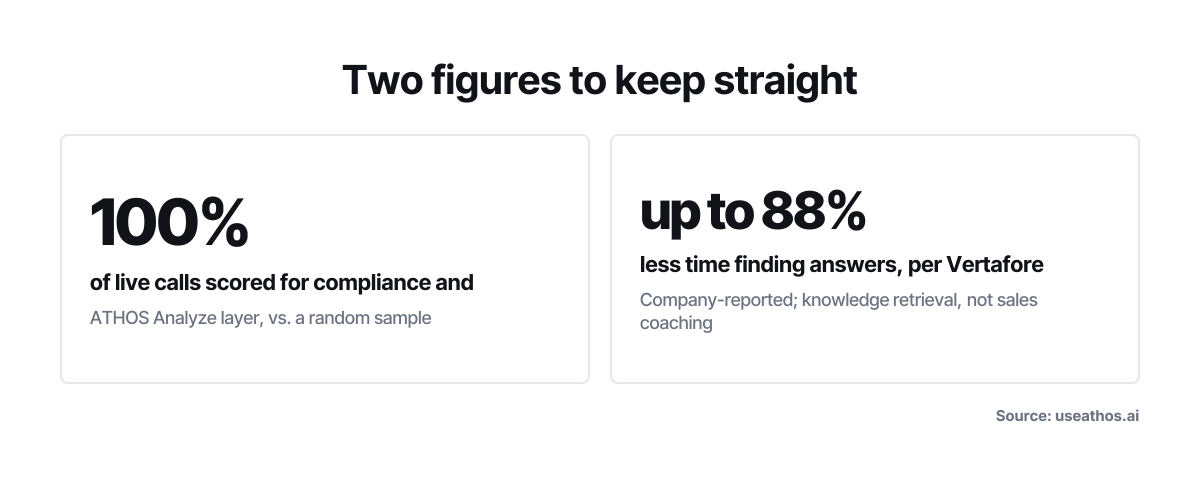
After: Every live call from the dialer is scored automatically for CMS compliance gaps, missed disclosures, script deviations and coaching opportunities. QA covers 100% of calls, not a sample. Read more on AI call scoring for insurance call centers.
The loop closes here. What the scores reveal about live calls becomes the next practice session. An agent who keeps missing the same disclosure gets drilled on it, rather than waiting for a manager to catch it in a sample.
AI Role-Play Coaching: Practicing Objections Without Burning Leads
A manager can run a handful of role-plays a week, and only when the calendar allows. AI prospects are available whenever an agent is, so the agent can run a full enrollment, miss, and run it again the same afternoon.
The bigger difference is that the prospect is unscripted. Your agent can't memorize a path through the call, because the prospect reacts to what the agent actually says. You can't fake your way through that, and neither can a new hire.
What realistic Medicare Advantage objections look like in a simulation
Real seniors push back in predictable ways. They worry about losing their doctor. They want to talk to their kids first. They've already got a plan and don't see why they'd change. They go off on a tangent and have to be brought back to the enrollment.
A good simulation throws all of that at the agent, mid-call, in natural language. The agent has to listen, answer the concern, and still move the enrollment forward without skipping required steps.
That last part is what scripted role-play misses. Handling an objection is one skill. Handling it while staying compliant is another, and you need both on the same call.
What good feedback after a practice call includes
A score alone teaches nothing. Feedback has to point at moments in the call.
Here's what to expect from useful post-call feedback:
- Where the call turned. The exact objection that stalled the enrollment.
- What was missed. Steps or disclosures skipped on the way through.
- What to try instead. A concrete alternative, not a generic tip.
- What to repeat. A follow-up scenario that targets the weak spot.
Your trainers should be able to read the feedback in two minutes and know what to work on. If they can't, the tool is generating reports, not coaching.
Compliance-Aware Coaching: CMS Gaps, Disclosures and SOA
Compliance problems rarely come from agents who don't care. They come from agents who forgot a step under pressure, and nobody noticed because the call was never reviewed.
Automated scoring changes who notices. Each call gets checked for missed disclosures, script deviations and CMS compliance gaps, so you see patterns across your whole floor instead of anecdotes from a sample. For more on the compliance side, see CMS compliance software for Medicare agents.
Turning call scores into targeted coaching
Scores are only useful if they change what an agent does on Monday. The workflow looks like this:
- Flag. The system scores every call and surfaces the gaps.
- Group. You spot the repeats: one agent, one disclosure, one team.
- Coach. The manager reviews the flagged moment with the agent.
- Practice. The agent runs a simulation built around the same gap.
- Recheck. The next live calls show whether it stuck.
This is why 100% coverage matters for coaching, not just for audit. With every call scored, your managers stop hunting for problems and start fixing the ones already found.
Where human oversight still matters
Software supports compliance review. It does not guarantee compliance, and it does not replace your compliance officer or legal counsel. This isn't legal advice.
Scoring flags what looks like a gap. A person decides whether it is one, what it means for your carrier contracts, and what to do about it. Your QA leads also still own the judgment calls the software can't make: unusual calls, edge cases, and anything that heads toward a formal complaint.
If a vendor tells you their tool makes you compliant, walk away.
What the Market Is Signaling: Source-Backed Coaching Agents
Big insurance vendors are now shipping coaching agents too. That tells you the category is real.
Vertafore launched its Velocity Coach Agent for insurance agencies. Vertafore says internal testing found it cut the time needed to find answers by up to 88%. That's a company-reported figure, not an independent one, so treat it as a claim and not a benchmark.
Read it for what it is. The job here is knowledge retrieval: helping someone find the right answer faster. That's valuable when your staff lose time hunting through documents.
It's a different job from sales and compliance coaching. Finding an answer doesn't teach an agent to handle a skeptical senior, close an enrollment, or deliver a disclosure at the right moment. Faster answers won't fix a weak close rate.
When you compare vendors, ask which job each tool does. You may need both. Just don't buy one and expect the other.
How to Evaluate AI Coaching Software Before You Buy
Demos make everything look good. Use a checklist so you compare tools on the same ground.
A checklist for sales, training and QA leaders
Hold every vendor to these six:
- Insurance-specific scenarios. Medicare Advantage objections, enrollment flow and senior prospects, not generic sales calls.
- 100% call coverage. Every live call scored, not a sample with a nicer label.
- Dialer integration. Calls should flow in from your dialer automatically, with no manual uploads.
- Evidence-backed scoring. Each score should point to the moment in the call that caused it, so a manager can check it.
- Human review. A clear path for QA to confirm, override and escalate.
- Ramp metrics. A way to track time to first close, lead conversion on new hires and repeat compliance gaps, so you can see whether the tool works.
Sales leaders should push hardest on items 1 and 6, training managers on 1 and 4, and QA and compliance leads on 2, 4 and 5. If a tool is strong on one and weak on the rest, you've bought a point solution.
Questions about data, integrations and rollout
Before you sign, get plain answers to these:
- Which dialers does it connect to, and who does the setup?
- Where are call recordings and transcripts stored, and who can see them?
- Can your QA team see why a call got a score, not just the number?
- How are simulation scenarios built and updated as plans and rules change?
- What does a typical rollout look like for a team your size?
- Which Medicare, Final Expense or ACA scenarios are covered out of the box?
Vague answers are an answer. If the vendor can't be specific about data and rollout, expect the same vagueness after you buy.
If you want to check these against a product built around Screen, Train and Analyze, see the full ATHOS feature set.
Frequently asked questions
Does AI coaching replace sales managers and trainers?
No. It takes over the repetitive work: running practice calls and scoring every recording. Managers still review flagged moments, coach agents one on one and make the hiring decisions. The difference is they spend their time on calls that need attention, not on hunting for them.
How is AI call scoring different from my current QA process?
Most QA teams listen to a random sample of calls. Automated scoring checks every live call from the dialer for CMS compliance gaps, missed disclosures and script deviations. That means you see patterns across the whole floor, not only in the calls someone happened to pull.
Can AI coaching software guarantee CMS compliance?
No, and any vendor that says so is overselling. The software flags likely gaps and helps you coach them. Your compliance team and legal counsel still decide what counts as a violation and how to respond.
Does this work for Final Expense and ACA teams, or only Medicare Advantage?
ATHOS is built for Medicare agencies, FMOs and carriers, and it also serves Final Expense and ACA/Under-65 sales teams. Whatever you sell, ask any vendor to show scenarios that match your product and your prospects.
Which ramp metrics should I track after rollout?
Track how long it takes new agents to reach their first close and how well they convert on live leads. Also track how often the same compliance gap shows up on their calls. Compare those numbers with your last cohort of new hires to see whether the tool is working.