
Automated Speech Analytics for Insurance: Score Every Call
Hunter Correll, Co-founder, ATHOS ·

Your QA team hears a small slice of your calls. Everything else goes unheard.
That gap is where missed disclosures, SOA mistakes and off-script pitches live. Automated speech analytics for insurance closes it by transcribing and scoring every call, not just the ones a reviewer happens to pull. This guide covers how it works, what it catches, where it stops and how to pilot a tool without losing a quarter.
What Automated Speech Analytics Means for Insurance Call Centers
In an insurance call center, automated speech analytics is software that turns call audio into text, then applies rules and AI to score each conversation against your standards. It runs on every recording your dialer produces. Nobody has to pick calls or sit through them.
The old model works differently. A QA reviewer pulls a few calls per agent, listens to each one and fills out a form, so feedback lands days or weeks after the behavior that caused the problem.
That is a spot check. It is not coverage.
Transcription, scoring and flagging: the three layers
Three layers do the work, and each one depends on the one before it.
- Transcription. Speech-to-text converts the call into a searchable record with the agent and the prospect separated.
- Scoring. Rules and AI check the transcript against a scorecard. Was the SOA captured? Were the required disclosures read? Did the rep stay on script?
- Flagging. Exceptions rise to the top. Reviewers see the calls that failed a criterion instead of a random pile.
A weak transcript produces a weak score, so you should judge any tool on all three layers, not on the dashboard alone.
Why Sample-Based QA Fails Medicare and Final Expense Teams
Random sampling made sense when the only option was a person with headphones. It stops making sense the moment every call is already recorded.
What slips through when you audit a small sample
Sampling catches problems that happen constantly. It misses the ones that happen once, on a call nobody opens.
Take a typical case. A rep skips a required disclosure on one call. That call sits in a batch no reviewer samples, so the miss never surfaces. With full-coverage scoring, the same call is flagged the same day, while the rep is still on shift and the call is fresh.
The same blind spot hides:
- SOA steps that were rushed, reordered or never completed
- Mandatory language that was paraphrased or dropped
- Pitches that drift off the approved script
- Objections the rep talked past instead of answering
- New hires who improvise because nobody is listening yet
The cost: chargebacks, burned leads, regulatory exposure
Each unreviewed bad call carries a price, and you pay it later, in bigger units.
- Chargebacks and lost commissions. Enrollments that should not have been written come back as clawbacks.
- Burned leads. Every paid lead a weak closer wastes is gone. You cannot re-dial a senior who already had a bad call.
- Regulatory exposure. Gaps that no one reviewed are gaps you cannot explain to a carrier or auditor.
Hunter Correll and Jason Paradise ran Medicare agencies before they built ATHOS. They built it to fix their own hiring, ramp and compliance problems, and the QA problem was the same one you probably have: too many calls, too few reviewers, and no way to know what the unheard calls contained.
What Speech Analytics Can Detect on an Insurance Call
This is the working end of the technology. The signals fall into two groups: compliance and sales behavior. Each applies across Medicare Advantage, Final Expense and ACA/Under-65 calls, though your scorecard criteria will differ by line.
Compliance: SOA, mandatory disclosures and CMS gaps
Compliance scoring checks whether required steps happened, in the call, in the right place. Typical signals include:
- SOA captured before the plan discussion began
- Required disclosures read, and read before the rep moved on
- Recording notices and consent language delivered
- Language that conflicts with your carriers' or CMS requirements
ATHOS scores every live dialer call automatically for CMS compliance gaps and missed disclosures, so QA covers 100% of calls rather than a sample. For a deeper look at this use case, read about CMS compliance software for Medicare agents.
Sales behavior: script deviations, objection handling, coaching moments
The same transcript tells you how your agents sell. Scoring can surface where a rep left the script, where a prospect raised a concern and the rep skipped past it, and where a strong call did something worth copying.
That last point matters. You are not only hunting for failures. The calls your best closers make become the examples you coach to, and you find them without listening to hundreds of hours.
Each flag becomes a coaching target with a timestamp attached. A manager who used to say "you need to handle objections better" can now say "listen to 4:12 on this call."
Limits of automated scoring and where humans still decide
Automated scoring does not give you legal sign-off, and it does not guarantee compliance. It tells your QA team where to look, and your compliance lead still decides what a flagged call means and what to do about it.
Three limits are worth knowing before you buy:
- Context. A phrase can pass a rule and still mislead a caller. A person has to judge tone and intent on edge cases.
- Audio quality. Bad connections, crosstalk and heavy accents can degrade a transcript, and a degraded transcript degrades the score.
- Rule changes. When a carrier updates its requirements, a person has to update the scorecard.
This is not a tool for replacing your reviewers. It is for agencies that want reviewers spending time on the calls that matter, not on finding them.
How Automated Call Scoring Works Step by Step
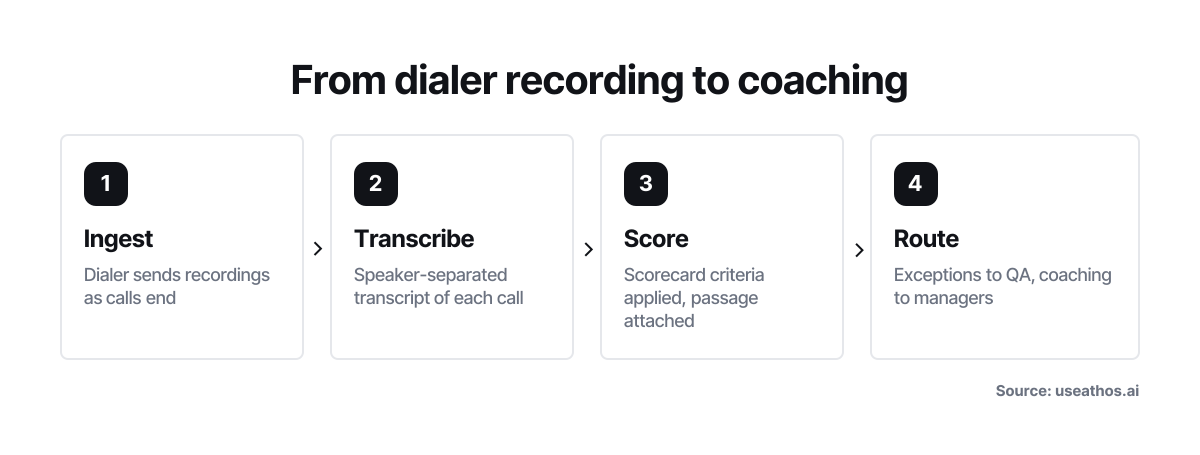
The pipeline is simple to describe and easy to test. Here is what happens from recording to coaching.
From dialer recording to scorecard
- Ingest. The dialer sends recordings to the platform as calls end, so nothing waits for a manual upload.
- Transcribe. Speech-to-text converts each recording into a speaker-separated transcript.
- Score. The platform applies your scorecard criteria to the transcript and records a pass, fail or partial for each one, with the matching passage attached.
- Flag. Calls with missed disclosures, SOA problems or major script deviations are marked as exceptions.
- Route. Exceptions go to QA for review, and coaching opportunities go to the agent's manager.
The attached passage is the part to check. A score you cannot trace back to words on the call is a score you cannot defend to an agent, a carrier or your own compliance lead.
Building a scorecard that matches your carriers' and CMS rules
A scorecard is only as good as its criteria. Start with the required elements, such as the SOA and disclosures, and separate hard fails from softer coaching items. A missed disclosure should not carry the same weight as a flat greeting.
Your compliance lead owns the criteria list, because the tool does not decide what compliant means for your carriers. Build it from your carrier contracts and your own call scripts.
Then tune it against people. Have two or three QA reviewers score the same set of calls without seeing the automated results, compare the two sets and fix every gap. Where the model flagged something a human passed, tighten the rule. Where it missed something a human caught, add the phrasing it did not recognize.
If you are comparing AI call scoring software for insurance call centers, this tuning loop is the part to ask about first.
Turning Call Analytics Into Coaching and Faster Ramp
Scores do nothing until someone acts on them. The payoff comes when a flagged gap becomes a coaching target the same week, and when the rep fixes it before the next live call.
Slow ramp usually comes from slow feedback. A new agent who makes the same mistake for three weeks before anyone hears it has burned three weeks of paid leads. When scoring flags the mistake on day one, you coach it on day two.
Closing the loop with role-play practice
Coaching works best when the rep can practice right away, and a live lead is the most expensive place to do that. In ATHOS, new agents practice full enrollments against unscripted AI senior prospects who raise real Medicare Advantage objections. A flagged gap, such as a skipped disclosure or a missed objection, becomes the next practice scenario. Read more on AI role-play training to ramp agents faster.
The loop starts even earlier. Pre-hire sales assessments let you interview only candidates who can already sell, so the calls you score belong to people worth coaching.
How to Evaluate Speech Analytics Tools for an Insurance Agency
Generic call-center tools transcribe well and score badly for insurance, because they do not know what an SOA is. Insist on a demo using your own recordings, not a polished sample.
Questions to ask vendors
- Does it score 100% of calls? Sampling in disguise defeats the purpose.
- Are the scorecards built for insurance? Look for SOA, disclosure and CMS-related criteria, not just sentiment and talk time.
- Does it integrate with your dialer? Manual exports mean calls get missed.
- Can you audit each score? Every result should link to the transcript passage behind it.
- How does it handle senior callers and accents? Test it on your own audio, because accuracy on your callers is the only accuracy that matters.
- Who edits the scorecard? You should be able to change criteria when a carrier changes its rules, without a support ticket.
Rollout checklist for the first 30 days
A pilot should prove two things: that the scores match your reviewers, and that your managers use the output.
- Week 1: connect the dialer, load a scorecard built from your carrier requirements and run a batch of past calls.
- Week 2: have QA score the same calls by hand and compare the results line by line.
- Week 3: tune the criteria, then turn on live scoring for one team.
- Week 4: review the flagged exceptions with managers, and count how many were calls no reviewer would have sampled.
The week 4 count is your business case. If full coverage surfaced problems sampling would have missed, you have the answer in your own data.
Get Full Call Coverage Without Adding QA Headcount
Adding reviewers scales cost linearly and still leaves most calls unheard. Scoring every call scales the listening, so your team can spend its hours on the exceptions.
If your 2027 plan includes more agents, more lead spend or a heavier compliance load, fix coverage now. You can see how ATHOS scores calls, then run it against a batch of your own dialer recordings and find out what your current sample is missing.
Frequently asked questions
Does speech analytics replace human QA reviewers?
No. It scores every call and flags the exceptions, so reviewers spend their time on the calls that need judgment. Your QA and compliance people still decide what a flag means and what to do about it.
Can automated call scoring guarantee CMS compliance?
No. It shows you where required steps like the SOA or a disclosure were missed, which gives you far better visibility than sampling. It is a QA tool, not legal sign-off, so your compliance lead keeps the final call.
How is speech analytics different from call recording?
Call recording stores audio that someone still has to listen to. Speech analytics transcribes the audio, scores it against your criteria and flags problems. With recording alone, you only find out what a call contained if a person picks it.
How accurate is transcription on senior callers and accents?
It varies by tool and by audio quality, so don't take a vendor's word for it. Run the tool on your own recordings, have reviewers compare the transcripts with the audio, and check that each score points to the passage behind it.
How long should a speech analytics pilot take?
About 30 days is enough. Spend the first weeks connecting the dialer and comparing automated scores with human reviews, then run live scoring for one team and review the exceptions with managers.