
Conversational Intelligence for Insurance: Score Every Call
Hunter Correll, Co-founder, ATHOS ·

Your agents talk to seniors all day. You hear almost none of it.
That gap is where the money leaks. A rep skips a disclosure, a Scope of Appointment (SOA) confirmation goes unrecorded, a new hire fumbles a "my doctor isn't in your network" objection. You find out weeks later, when the chargeback lands or an auditor asks questions.
Conversational intelligence for insurance closes that gap. Here is what it is, how it works on a Medicare call, and what to check before you buy.
What Conversational Intelligence for Insurance Actually Is
Conversational intelligence is software that records, transcribes and analyzes real calls between your agents and customers. It then surfaces compliance gaps, objections and coaching moments from what was actually said.
It listens to humans. It does not talk to them.
In insurance, the useful version knows the work. It checks whether the agent confirmed the SOA, read the required disclosures and stayed inside the approved script. A generic sales-call tool built for software demos does not know what a Medicare Advantage enrollment requires, so it can't tell you when one goes wrong.
Conversational intelligence vs. conversational AI chatbots
Search results blur these two categories. They do different jobs.
- Conversational intelligence analyzes recorded conversations between people. It produces scores, flags and coaching notes for managers.
- Conversational AI is the chatbot or voice agent that handles the customer interaction itself, in chat or by phone.
One audits your team. The other replaces a channel. If you run a licensed phone sales floor, you want the first, because the agent's judgment on the call is the thing you need to see.
This does not make your agents better by itself. It shows you what happened on the call. You still have to coach on it.
Why Sample-Based QA Fails Insurance Phone Teams
Most QA programs pull a handful of calls per agent, listen, and fill out a form. Everything else goes unheard.
That is a coverage problem, not an effort problem. Even a diligent QA lead can only listen to so many hours, and a random pull is just as likely to land on a clean call as a bad one. You can't build a defensible process on whatever the sample happened to catch.
The cost of the calls nobody reviews
Take a typical case. A rep skips a mandatory disclosure on a Medicare Advantage enrollment. The sample misses it. Nothing happens for weeks, and then it surfaces as a chargeback or an audit issue, long after the rep has repeated the same mistake on dozens of other calls.
With every call scored, the same miss is flagged the same day. You coach once, early, before the habit sets.
A pattern like this is invisible in a sample and obvious in full coverage, and for Medicare and Final Expense teams that is the difference between fixing a rep on Tuesday and explaining a file to a carrier next quarter.
Chargebacks, burned leads and slow ramp as downstream symptoms
Unheard calls show up elsewhere on your P&L:
- Chargebacks and lost commissions. Enrollments that should not have been written, or were written without the right confirmations, unwind later.
- Burned leads. Paid leads go to agents who can't close, and you can't tell which objections they're losing on.
- Slow ramp. New hires get generic feedback from a sample, so the same errors repeat for weeks.
Each one traces back to the same blind spot. You are managing a floor you mostly can't hear.
How Conversational Intelligence Works Across a Medicare Call
Here is the path from dial to coaching action:
- The call runs through your dialer and is recorded.
- The audio is transcribed, with agent and customer separated.
- The transcript is scored against your compliance and sales criteria.
- Gaps and coaching moments are flagged to the right manager.
- The manager coaches on a specific moment, not a general impression.
Each step matters. Skip one and the output turns to noise. For a deeper look at the scoring step, see AI call scoring software for insurance call centers.
Transcription and speaker separation
Everything downstream depends on an accurate transcript that knows who said what. If the system attributes the customer's "yes" to the agent, an SOA confirmation looks complete when it isn't.
Speaker separation also lets you measure the agent alone: talk time, interruptions, whether they asked the required questions or only answered them. Insurance calls are long and full of plan names, drug names and carrier terms, so you should test any tool on your own recordings before you trust its accuracy.
Scoring against compliance and sales criteria
This is the heavy lifting. Each call is checked against a scorecard built for your line of business. On a Medicare call, that means looking for:
- CMS compliance gaps: statements or omissions that conflict with the rules your carriers hold you to.
- Missed disclosures: required language that was never said, or said too fast to count.
- SOA confirmation: whether the appointment scope was confirmed and recorded before the plan discussion began.
- Script deviations: places where the agent left approved wording.
- Sales behaviors: discovery questions, objection handling and the ask for the enrollment.
A scorecard works only if the criteria are specific. "Was the agent compliant?" is not a criterion. "Was the required disclosure read before enrollment began?" is.
Flagging coaching opportunities automatically
A score alone doesn't change behavior. The useful output is the moment: the agent froze on a pharmacy-network objection, or talked over the customer during the disclosure.
Automatic flags point your managers to those moments, so they spend time coaching instead of hunting for calls to coach on. Your best manager stops being a bottleneck, because you no longer need to listen to a whole call to find the thirty seconds that matter.
Core Use Cases: Compliance, Coaching and Sales Performance
Each use case maps to one pain you already feel. The before and after is the same in all three: you go from guessing to knowing.
Call compliance scoring for Medicare Advantage, Final Expense and ACA
Before: a sample of calls, reviewed days or weeks late, with problems found by auditors or carriers.
After: 100% of calls scored for CMS compliance gaps and missed disclosures, with flags raised the same day.
The rules differ across lines. A Final Expense call and a Medicare Advantage call need different disclosures, and ACA teams work under their own requirements. Your scorecard should reflect each line separately. For more on the risk side, read about CMS compliance software for Medicare agents.
Be clear about the limit. These tools support your compliance review. They do not guarantee compliance, and they do not replace your compliance officer or legal counsel, who still decide what your scorecard should say and what to do with a flagged call.
Coaching from real calls instead of gut feel
Before: a manager remembers one bad call and coaches the rep on that.
After: a manager sees the three gaps that repeat across a rep's week and coaches on those, with the exact moments in hand.
Reps believe feedback more when they can hear themselves. A timestamped moment beats "you need to handle objections better."
Spotting objection patterns that cost enrollments
Before: you suspect reps lose deals on certain objections, but you can't prove which.
After: you see which objections come up most, where reps stall, and how your top closers answer them.
That last part is the payoff. Your best agent's handling of the doctor-network question becomes a model the whole floor can copy, instead of something that lives in one person's head.
Closing the Loop: Connecting Call Insights to Hiring and Training
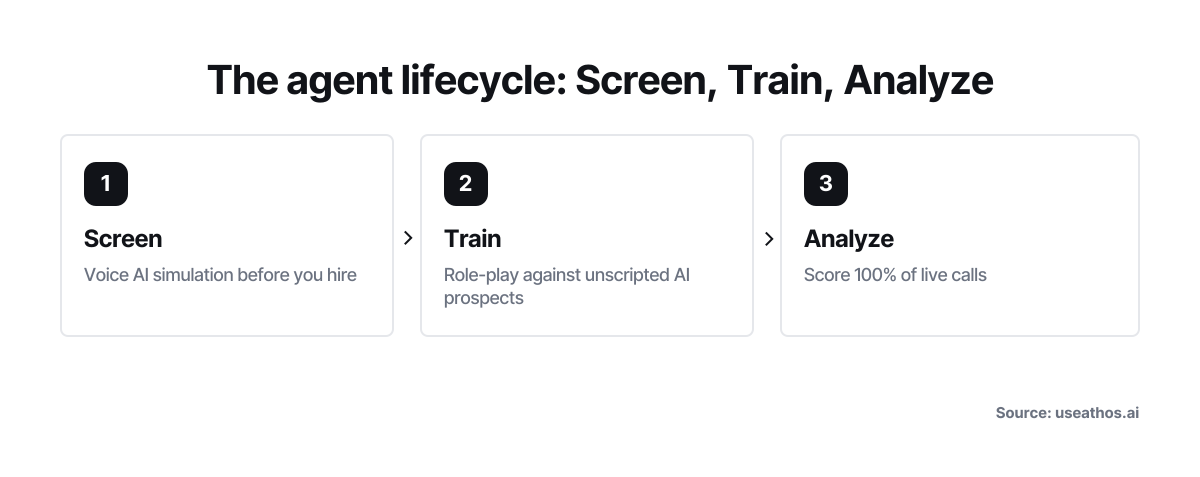
Analysis alone only tells you what went wrong. The value comes when findings flow back into who you hire and how you train. That is the full lifecycle: Screen, Train, Analyze.
Feeding live-call findings into AI role-play practice
Say your call data shows new reps stumbling on the same Medicare Advantage objection. You don't need to send them back to the phones to fix it on paid leads.
You build that scenario into practice. Agents run full enrollments against unscripted AI senior prospects that raise real objections, and they repeat the scene until it holds. Live-call weak spots become practice scenarios, and your leads stay unburned. Here is more on AI role-play training that ramps agents faster.
Practice does not replace live coaching. It gives reps safe repetitions between the calls that count.
Using pre-hire simulations so you only interview reps who can sell
The loop starts before day one. Candidates take a voice-based AI sales simulation before you hire them, so you interview only the people who can actually sell. This is where pre-hire sales assessments for insurance agents fit.
That protects the rest of the chain. Fewer weak hires means less training time wasted, fewer leads burned and fewer compliance misses to catch.
What to Look For When Evaluating Conversational Intelligence for Insurance
Most vendors will demo well. Your job is to find the ones that hold up on your calls, with your carriers' rules, under an auditor's questions.
Ask for a trial on your own recordings. Marketing demos use clean audio and cooperative customers, and your floor has neither.
Evaluation checklist for QA and compliance leads
- 100% call coverage. Does every dialer call get scored, or does the tool sample too? Ask what happens when call volume spikes.
- Insurance-specific criteria. Does it understand SOA, plan disclosures and Medicare Advantage, Final Expense and ACA differences out of the box, or do you build everything from zero?
- Dialer integration. Can it pull calls from your existing dialer without manual uploads?
- Scoring transparency. When a call fails, can you see which sentence triggered the flag and why? A black-box score is hard to defend to a carrier.
- Auditability. Can you keep a record of scores, flags and who reviewed them, and pull it when asked?
- Coaching workflow. Do flags reach managers with the exact moment attached, and can you track whether coaching happened?
Questions worth putting to every vendor:
- How is your scorecard built, and can we edit it?
- How do you handle a call where the speakers overlap?
- Who on your team has run a Medicare sales floor?
- What does your tool say it cannot do?
That last one is the most useful. A vendor that promises guaranteed compliance is telling you something about how they work. ATHOS was founded by Medicare agency owners Hunter Correll and Jason Paradise, who built it to fix their own hiring, ramp and compliance problems. Ask any vendor what experience sits behind the product.
Rolling It Out Without Disrupting Your Floor
You don't need a quarter-long project. You need a scorecard and a week of calls.
- Scorecard first. Write the criteria for each line of business: required disclosures, SOA confirmation, approved script points, core sales behaviors. Get compliance to sign off.
- Dialer connection. Link the dialer so every call flows in without anyone uploading files.
- One-week baseline. Let a week of calls run through before you change anything. This shows where you stand today, by agent and by team.
- Top gaps only. Pick the two or three gaps that repeat most. Coach on those, and leave the rest for later.
- Weekly trend check. Track scores by agent and by gap each week. Watch whether coaching moves them.
Don't announce it as surveillance. Tell your agents it exists to help them close and keep their enrollments, because that is true.
Your next step is simple. See how ATHOS covers Screen, Train and Analyze, and look at how it scores every live call and sends the findings straight into training.
Frequently asked questions
Is conversational intelligence the same as a call recording tool?
No. A recorder stores audio and leaves a person to listen. Conversational intelligence transcribes the call, scores it against your criteria and flags the moments that need attention, so you don't depend on someone happening to pick the right call.
Can call analysis guarantee my agency is CMS compliant?
No. These tools support your compliance review by flagging gaps like missed disclosures, SOA issues and script deviations. Your compliance officer and legal counsel still decide what the criteria should be and how to act on a flagged call.
What can call analysis detect on a Medicare call?
It can flag CMS compliance gaps, missed disclosures, missing SOA confirmation and script deviations. It can also surface coaching opportunities such as stalled objection handling. How well it does this depends on how specific your scorecard is.
How does call analysis help new agents ramp faster?
It shows managers the specific moments each new rep is struggling with. Those weak spots can become practice scenarios against AI senior prospects, so reps fix them without burning paid leads.
What should I ask a vendor before buying?
Ask whether every call is scored or only a sample. Ask whether the criteria are built for insurance, whether you can see why a call was flagged, and whether it connects to your dialer. Also ask what the tool cannot do.