
The Real Cost of a Bad Insurance Agent Hire
Hunter Correll, Co-founder, ATHOS ·

You hired a licensed agent. They took your training, burned through live leads, and left in 90 days. Your books show a salary or draw and a recruiting fee. They don't show the rest.
The rest is where the cost of a bad insurance agent hire actually lives: leads that never converted, hours your best manager spent on a rep who wasn't going to make it, chargebacks, and a seat that's empty again. This article walks the full stack and gives you a calculator to run against your own numbers.
Why the Generic Cost of a Bad Hire Number Undersells Your Problem
The famous benchmarks were built for office jobs. Nobody modeled a licensed phone agent who spends paid leads on every mistake.
That gap is what this article fills.
What the standard benchmarks say
Here is what the published numbers look like:
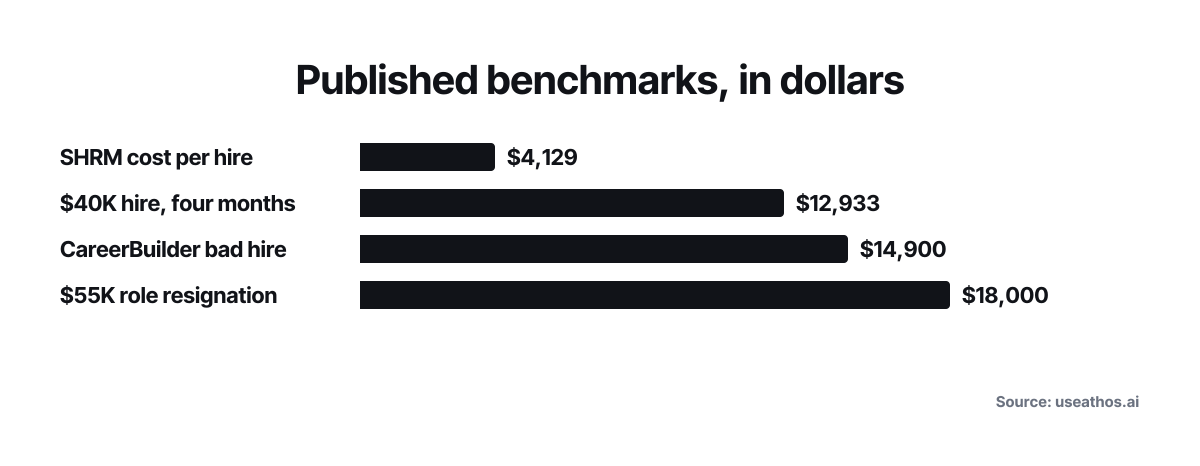
- $14,900: the average loss per bad hire, according to a 2017 CareerBuilder survey. In the same survey, 74% of employers admitted they had hired the wrong person.
- $4,129: SHRM's 2016 average cost per hire. That covers only filling the job, not the cost of a hire that fails.
- 30% of first-year earnings: the level CIPD says a bad hire can easily exceed, rising to as much as 400% of annual salary for senior or specialist roles, as Adria Solutions reports.
These figures are useful as a floor. They are not your number.
An agent in a call center doesn't just draw pay while underperforming. Every lead they work is a lead you paid for, and every call carries disclosure and consent requirements that a miss can turn into a chargeback or a compliance problem. A benchmark averaged across industries has no line for any of that, so if you plan around it, you will undercount, and you will do it every time you review a failed hire.
The Full Cost Stack of a Bad Insurance Agent Hire
Think of it as four layers. The first is the only one most hiring articles price. The other three are where Medicare, Final Expense and ACA teams lose real money, and you can price all of them from data you already hold.
I'm deliberately not putting dollar figures on lead, chargeback or compliance costs. Your cost per lead, your close rates and your carrier chargeback terms are specific to you, and a made-up average would only mislead you.
Direct costs: recruiting, licensing and onboarding
This is the visible layer. Add up job ads, recruiter fees, interview time, licensing and appointment costs, and any onboarding spend such as software seats and equipment.
SHRM's $4,129 average cost per hire is the floor here. It tells you what it costs to fill the seat once, and nothing about what happens when the person in it can't sell.
Pull your own figure from finance. If you pay for state licensing or carrier certification on behalf of new reps, include it.
Lead spend burned on reps who can't close
This is the line generic articles skip entirely.
A new rep who can't handle objections doesn't just fail to sell. They use up leads you paid for, and live leads don't come back. A senior who called once and got a fumbled pitch is rarely going to take your second call.
To price it, take the leads a departed agent worked from day one to exit. Multiply by your average cost per lead. Then subtract what a baseline rep would have converted on the same leads, using your own close rate.
That gap is your burned-lead cost. It often outweighs the direct costs, because lead spend is continuous while recruiting is a one-time charge.
Training hours and manager time
Training has two meters running. The new hire's paid hours are one. The trainer's or manager's hours are the other.
Count every hour spent on classroom sessions, call shadowing, one-on-one coaching and side-by-side calls. Multiply by the hourly rate of whoever delivered it. Include the opportunity cost if your top closer was pulled off the phones to babysit.
When a hire fails, all of that time is lost with them. The longer they stay before leaving, the bigger the sunk cost.
Chargebacks, lost commissions and compliance fallout
A rep who writes poor-fit or poorly documented enrollments creates costs that show up months later. Chargebacks claw back commissions. Cancelled or rescinded business wipes out revenue you already booked.
Compliance is the layer that can grow past everything else. A missed disclosure, a skipped scope-of-appointment step or a script deviation can bring carrier scrutiny and regulatory risk. And if you only audit a small sample of calls, you may not see the problem until it has repeated dozens of times.
Quantify what you can: chargebacks tied to the agent, commissions lost to cancelled business, and the hours spent on remediation. If you want to understand how call monitoring ties into this layer, see CMS compliance software for Medicare agents. This is not legal advice, and no tool removes your obligation to follow CMS rules.
Cost of Agent Turnover: What One Resignation Does to Your Pipeline
Turnover compounds. Each exit restarts recruiting, licensing, training and ramp from zero, and the seat produces nothing while that happens.
The generic numbers show how fast it adds up. One resignation on a $55,000 role can cost $18,000 or more. A $40,000 hire who lasted four months totals $12,933 in calculated cost, according to Hiring Academy's worked examples. Those are office-job figures with no lead spend and no chargebacks in them, so your real cost of agent turnover is higher.
Rehire cycle and ramp time reset
Think about what happens on the day an agent quits.
You post the job again. You interview again. You license and appoint again. Then the new hire needs weeks to reach productive call volume. Meanwhile your leads are either going unworked or getting handed to someone else, which dilutes that person's performance.
If your average ramp is long, every early exit throws away the whole investment. A rep who leaves just as they become productive costs you the full ramp and gives you none of the payoff.
Team morale and the ripple effect
Your remaining agents notice who leaves and why. They pick up extra leads, sit in on more coaching, and watch a revolving door spin.
None of this appears on a spreadsheet, and I won't pretend it has a verified dollar value. But if your top reps are covering for failed hires, you're paying for it in their output and, eventually, in their resignations.
What about the failure rate of insurance agents?
You will find numbers online. We haven't found a verified, sourced failure rate for insurance agents that we'd stand behind, and definitions vary: failed to get licensed, failed to write a policy, left within 90 days, or was terminated for compliance.
So track your own. At minimum, log each hire's exit date, time to first enrollment, leads worked before exit, and chargebacks attributed to them. After a year you will have a failure rate that reflects your market, your lead sources and your process, which is the only one that helps you decide anything.
A Bad Hire Cost Calculator You Can Run Today
This bad hire cost calculator extends the Hiring Academy formula with the lines that matter in insurance sales. It won't predict who will fail. It tells you what the last failure cost.
Step-by-step formula
- Recruiting costs. Ads, recruiter fees, interview time, licensing, onboarding.
- Pay for the underperformance. Salary or draw, multiplied by months employed, multiplied by the performance gap (the share of expected output the rep didn't deliver).
- Management time. Hours spent on training, coaching and remediation, multiplied by the hourly rate of the people who spent them.
- Burned leads. Leads worked by the agent, multiplied by cost per lead, minus the value a baseline rep would have converted.
- Chargebacks and lost commissions. Everything clawed back or cancelled that traces to this agent.
- Compliance cleanup. Hours and costs spent fixing flagged calls or enrollments.
- Rehiring. The cost of the next cycle, starting with line 1 again.
Add lines 1 through 7. That is your total.
Worked example with your own inputs
Start with the generic baseline. A $40,000 hire who lasts four months comes to $12,933 on the standard formula. That number covers lines 1 through 3 and 7, and nothing else.
Now pick one agent who left in the last year. Fill in lines 1 to 3 from payroll and your manager's calendar. For line 4, pull the lead log and count what the rep touched. For line 5, ask your carrier-facing or commissions team for chargebacks tied to that agent's name.
Compare the result with the baseline. The distance between them is what generic articles leave out, and it tells you which layer of the stack is hurting you most.
Hiring Mistakes in Insurance Sales That Create Failed Hires
Most failed hires trace back to a short list of hiring mistakes in insurance sales. If you recognize two of these in your process, expect the calculator to hurt.
- Hiring on résumé and interview charm. A smooth talker in a conference room is not the same as a rep who handles a skeptical 72-year-old on a recorded line.
- No skill test before the offer. You find out whether they can sell only after you've paid to license and train them.
- Putting untrained reps on live leads. Practice on paid leads is the most expensive practice you can buy.
- Sampling a few calls for QA. Problems repeat for weeks before anyone sees them.
You're not alone. In the CareerBuilder survey, 74% of employers said they'd hired the wrong person. The difference is that your wrong hire also burns inventory you paid for.
How to Cut Failed Sales Hire Impact Before It Starts
You can't remove every bad outcome. You can move the discovery earlier, when it costs less. The founders of ATHOS, Hunter Correll and Jason Paradise, ran Medicare agencies themselves and built the platform to fix their own hiring, ramp and compliance problems. The three steps below follow that same order: Screen, Train, Analyze.
Screen with a simulated sales call before the offer
Before: you interview, make an offer, and learn six weeks later that the rep can't close.
After: candidates take a voice-based AI sales simulation first, and you interview only the ones who can sell. The expensive part of failure, the license, the training and the leads, never starts for the others.
A simulation doesn't replace judgment about attitude, reliability or fit. It gives you evidence about selling skill that an interview can't. For the full approach, see our guide to a pre-hire sales assessment for insurance agents.
Ramp on role-play, not paid leads
Before: new agents learn objection handling on live seniors you paid to reach.
After: they practice full enrollments against unscripted AI senior prospects who raise real Medicare Advantage objections. Mistakes cost nothing, and you see who's ready before a live lead is at stake. Read more on AI role-play training to ramp faster.
Audit 100% of calls to catch problems early
Before: QA reviews a small random sample, and a bad pattern can run for weeks.
After: every live call from the dialer is scored automatically for CMS compliance gaps, missed disclosures, script deviations and coaching opportunities. That means scoring 100% of calls automatically, so you can coach or exit a struggling agent early. Scoring flags issues for your team to review. It does not guarantee compliance on its own.
Put a Number on Your Own Bad Hires
Do this today, not next quarter.
- Pull the list of agents who left, or were let go, in the last 12 months.
- Run each one through the seven-line calculator above.
- Rank the results by which line is biggest: recruiting, burned leads, manager time, chargebacks or rehiring.
- Start fixing the largest line first.
If burned leads dominate, start with screening and role-play. If chargebacks and compliance dominate, start with call scoring. Either way, you now have a number to measure against.
When you have it, see how Screen, Train and Analyze work together and book a look at how pre-hire screening and full call scoring would run on your own team.
Frequently asked questions
How much does a bad hire cost?
Published benchmarks put it at an average of $14,900 per bad hire (CareerBuilder) and at 30% or more of first-year earnings (CIPD). For a licensed phone agent the real figure is higher, because burned leads, chargebacks and compliance cleanup sit on top. Run the seven-line calculator on your own departed agents to get your number.
What is the failure rate of insurance agents?
There is no verified figure we can stand behind, and definitions differ: unlicensed, never wrote a policy, left in 90 days, or terminated for compliance. Track your own exit dates, time to first enrollment, leads worked and chargebacks by agent. Within a year you'll have a rate that fits your market and lead sources.
Is SHRM's $4,129 cost per hire the cost of a bad hire?
No. It is the average cost of filling a job once. A failed hire adds pay for the underperformance, manager time, burned leads, chargebacks and a second round of hiring on top of that.
Which cost should I tackle first?
Fix whichever line is largest in your own calculation. If burned leads dominate, start with a pre-hire simulation and role-play ramp. If chargebacks and missed disclosures dominate, start by scoring every call instead of a sample.