
What to Look for in an Insurance Agent Training Platform
Hunter Correll, Co-founder, ATHOS ·

Most buyer guides for an insurance agent training platform read like LMS spec sheets. Course library. CE tracking. Quizzes. Completion certificates.
None of that tells you whether a new agent can walk a senior through a Medicare Advantage enrollment without fumbling the SOA or skipping a disclosure.
You aren't buying a library. You're buying a shorter ramp, fewer burned leads and fewer compliance misses. ATHOS was built by Medicare agency owners Hunter Correll and Jason Paradise to fix their own hiring, ramp and compliance problems, and this checklist comes from that angle.
What to Look for in an Insurance Agent Training Platform: The Short Checklist
Run every vendor through three tests. If a platform fails one, no feature list will save it.
- Roleplay realism. Agents practice full enrollments by voice against unscripted prospects before they touch a paid lead.
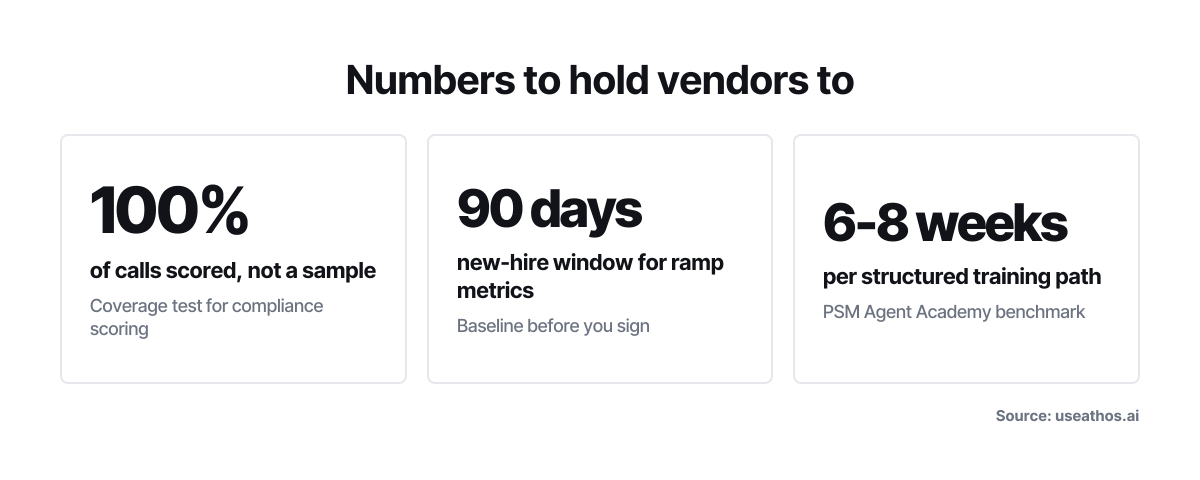
- Compliance scoring coverage. Every live call is scored, not a random slice of them, and each flag points to a moment in the call.
- Ramp-time proof. The vendor shows you how it measures time to first sale, live-lead burn and QA pass rate across a new hire's first 90 days.
Integrations, reporting and support still matter. They come after these three.
One limit up front: this checklist is built for phone-based sales teams. If all you need is CE credit tracking and a place to host PDFs, a basic LMS does that job and you can skip the rest.
Why Generic LMS Feature Lists Fail Phone-Based Sales Teams
Course-and-quiz platforms dominate the search results for insurance training software. They solve a real problem, which is proving that people were exposed to material. They don't solve the problem on your P&L, which is that agents who passed the quiz still lose the sale on the call.
Course libraries and CE tracking solve licensing, not closing
A quiz measures recall. A phone enrollment measures composure, sequencing and how an agent handles a senior who says "I need to talk to my daughter" halfway through the disclosures.
Watching video modules doesn't change that behavior. Only repetition under realistic pressure does.
Here is what the gap costs you:
- Burned leads. New hires learn on live prospects you paid for.
- Slow ramp. Reps wait weeks to get confident enough to close.
- Chargebacks and lost commissions. Missed disclosures and SOA mistakes surface after the sale, when fixing them is expensive.
Your QA team feels it too, because a feature list that ignores call behavior leaves them auditing a small sample and hoping it's representative.
Roleplay Realism: Can Agents Practice Full Enrollments Before Touching Live Leads?
Realism is the whole point. If practice is easier than a real call, agents learn to beat the practice, and you're back to burning leads. Four things define it: voice, unscripted prospects, the full enrollment flow, and real objection variety.
Unscripted prospects and real Medicare Advantage objections
A scripted branching scenario teaches agents to spot the right answer. A real senior doesn't follow a branch. They wander, interrupt, ask about their doctor, and circle back to price.
Look for AI prospects that generate their own responses and push back the way real Medicare Advantage prospects do. The simulation should run the entire enrollment, including the SOA and required disclosures, not just the opening pitch. Otherwise agents rehearse the easy 20% of the call and meet the hard part on a live lead.
If you want a deeper look at how this practice shortens ramp, see AI role-play sales training for insurance agents.
Voice-based practice vs. click-through scenarios
Selling happens out loud. Tone, pacing, silence and how fast someone recovers from an objection all live in the voice. A click-through scenario where an agent picks option B from four choices exercises none of it.
Voice practice also exposes what a quiz hides: the agent who knows every answer but can't say it smoothly under pressure.
Questions to ask in a vendor demo
Don't accept a canned walkthrough. Run this test instead:
- Your best closer runs the simulation cold, with no coaching.
- Your weakest rep runs the same scenario.
- You compare the scores and the transcripts side by side.
If the two scores don't separate, the simulation isn't measuring selling. If they separate and the scorecard explains why, you've found something worth paying for.
Then ask the vendor these questions:
- Does the prospect respond differently every run, or follow a fixed tree?
- Does the scenario cover the full enrollment, including SOA and disclosures?
- Can you load your own scripts and objections, and how long does that take?
- What does the agent see after a session, and what does the manager see?
If a vendor can't let you run the test on your own script, treat that as an answer.
Compliance Scoring Coverage: 100% of Calls or a Sample?
A QA team that reviews a random sample of calls can only report on the calls it reviewed. Every other call is a blind spot, and violations don't cluster politely inside your sample. A single missed disclosure on call 400 can turn into a chargeback, a lost commission or a carrier conversation you didn't want.
Automatic scoring changes the math: 100% of calls get reviewed, so QA stops sampling and starts managing exceptions. For more on how that works across a floor, see AI call scoring software for insurance call centers.
A clear limit: no scoring tool guarantees compliance, and nothing here is legal advice. Scoring cuts the odds that problems slip through unseen. Your compliance lead still owns the standards and the decisions.
What the scorecard must catch: CMS gaps, missed disclosures, SOA errors, script deviations
Ask the vendor to show a scored call, then check that the scorecard covers these:
- CMS compliance gaps against the rules your agents work under
- Missed disclosures, flagged by name, not buried in a general score
- SOA mistakes, including missing or misordered steps
- Script deviations, so you can tell a good improvisation from a risky one
- Coaching opportunities, so every score leads to a next action
Demand evidence, too. A flag that says "disclosure missed" with no link to the moment in the call is an accusation, not a coaching tool. Your managers need to click the flag and hear the exact seconds.
Criteria should be configurable. Your agency, your carriers and your scripts differ from the next shop's, and a fixed rubric will either miss your rules or flag noise. For a broader view of what to expect, read about CMS compliance software for Medicare agents.
Coverage, turnaround and dialer integration
Three practical questions decide whether scoring works day to day:
- Coverage. Does it score every call, or only calls you upload?
- Turnaround. Do scores land fast enough to coach the same week the call happened?
- Dialer integration. Do calls flow in automatically from your dialer, or does someone export recordings by hand?
Manual uploads quietly turn 100% coverage back into a sample. Insist on a direct dialer connection.
Ramp-Time Metrics That Prove the Platform Works
Every vendor says its platform speeds up ramp. Few can show you how they measure it. You need a baseline before you sign, because without one you can't tell whether the platform changed anything.
Measure the first 90 days of a new hire
Total CSR frames the test as what the software must do in two moments: a new hire's first 90 days and a producer's next license renewal. For a phone team, the first window is the one that costs you money, so use 90 days as your measuring period.
Baseline these four numbers on your current cohort:
- Time to first sale. Days from start date to first enrollment.
- Live-lead burn. How many paid leads a new hire works before they close one.
- QA pass rate. The share of scored calls that clear your compliance and quality bar.
- Overdue assignments. Training tasks past due, by agent and by team.
Then ask each vendor, in writing, how its platform measures each of these. If the answer is "you can export that," it doesn't measure them. You'd be building the report yourself.
Reporting a manager can read before a team meeting
Good reporting is boring and fast. Total CSR describes it as overdue assignments by team, quiz results by topic and license deadlines in the next 90 days, all on one screen a manager can read before a staff meeting.
For a sales floor, add the call side: QA pass rate by agent, top compliance flags this week, and who needs coaching first. If a manager has to open four tabs to learn who is behind on training or whose license expires next month, they won't do it, and the problem grows.
Screening, Onboarding and FMO Enablement: Does It Cover the Full Agent Lifecycle?
Stitching one tool for hiring, another for training and a third for QA creates gaps exactly where the data matters. Screening results never reach the trainer. Practice scores never reach QA. You lose the thread from "who we hired" to "how they perform on live calls."
ATHOS runs the lifecycle as three steps in one system: Screen, Train, Analyze. Candidates take a voice simulation, new agents practice enrollments, and live dialer calls are scored automatically. If you run an FMO, one system also means you can apply the same standards across downline agents instead of rebuilding the process for each agency.
Structured paths still have a place. PSM Agent Academy, for example, organizes training into paths of about 2 hours of video each, roughly 6-8 weeks per path alongside active selling, with Path 1 aimed at agents in their first 12 months. That's a useful benchmark for pacing. Simulated practice is the part video can't supply, so ask whether the platform lets you pair a structured path with real call rehearsal.
Pre-hire simulations that filter candidates before interviews
Interviews reward people who talk well about selling. A voice simulation shows you who can actually sell, before you spend a manager's hour on them or a license fee on onboarding.
When candidates take a simulation first, your managers interview only reps who can sell. Read more about a pre-hire sales assessment for insurance agents and what a good one measures.
A Vendor Scorecard You Can Use Before You Sign
Turn the sections above into a scorecard. Score each vendor 1 to 5 on every line, and double the first three, because they decide whether the platform changes call behavior.
- Roleplay realism (double weight). Voice-based, unscripted, full enrollment with SOA and disclosures. Best and weakest rep scores separate.
- Compliance scoring coverage (double weight). Every call scored, configurable criteria, evidence tied to call moments, coaching flags.
- Ramp proof (double weight). The vendor measures time to first sale, live-lead burn, QA pass rate and overdue assignments across the first 90 days.
- Integrations. Calls flow from your dialer with no manual uploads.
- Reporting. Overdue training, quiz results and license deadlines on one screen.
- Lifecycle fit. Screening, training and QA share data, and FMOs can scale it across downline agents.
- Support. The vendor helps you load your own scripts and objections before launch.
A vendor that scores well on lines 4 through 7 and poorly on 1 through 3 has sold you an LMS with nicer packaging.
The fastest way to fill in this scorecard is to run the tests yourself. Book a demo, bring your own script and a few of your own calls, and watch your best and weakest reps go head to head in the simulation. You can also see the full feature set before you do.
Frequently asked questions
Can AI roleplay really replace practice on paid live leads?
It can replace the first rounds of practice, where new agents make their worst mistakes. That only works if the practice is by voice, unscripted and covers the full enrollment, including the SOA and disclosures. Test it by having your best and weakest reps run the same scenario and checking that the scores separate.
Why does scoring every call matter more than a QA sample?
A sample only tells you about the calls you reviewed. Missed disclosures and SOA errors on the other calls go unseen until they show up as chargebacks or lost commissions. Scoring 100% of calls turns QA into exception management instead of guesswork.
Which ramp metrics should I baseline before buying?
Baseline four numbers across a new hire's first 90 days: time to first sale, live-lead burn, QA pass rate and overdue assignments. Then ask each vendor in writing how its platform measures every one. A platform that only lets you export raw data leaves you to build the report.
Does a call scoring tool guarantee CMS compliance?
No. It lowers the chance that problems slip through unseen by checking every call for compliance gaps, missed disclosures and script deviations. Your compliance lead still owns the standards and the decisions, and this isn't legal advice.
Should an FMO buy screening, training and QA separately?
Separate tools leave gaps between hiring data, practice scores and live call results. One system that covers Screen, Train and Analyze keeps those connected. For an FMO, it also lets you apply the same standards across downline agents.