
Insurance Dialer QA Automation: Score 100% of Calls
Hunter Correll, Co-founder, ATHOS ·

Your dialer can push hundreds of calls a day through a licensed agent team. Your QA team can review a few of them. That gap is where chargebacks start.
Insurance dialer QA automation closes it. Every call gets transcribed and scored, and the ones that need a human get flagged. This guide covers what gets scored, how to set it up, and how to tell whether it's working.
Why Sample-Based QA Fails Insurance Dialer Teams
Manual QA was built for small floors. A reviewer pulls a call, listens for 20 minutes, fills in a form, and moves on. Dialer volume outruns that process every single day.
So you audit a sample and hope it represents the rest. It doesn't, because the calls that hurt you are rarely the ones that land in the sample.
You also find problems late. A missed disclosure or a thin Scope of Appointment record usually surfaces after a complaint, a carrier audit or a chargeback, and by then the agent has repeated the mistake on dozens of calls.
What slips through when you audit 2% of calls
Whatever your actual sample rate is, the same things slip through:
- Missed disclosures. The agent skips a required statement on a rushed call, and nobody hears it.
- SOA gaps. The appointment record is incomplete or captured after the plan discussion started.
- Script drift. A new agent starts improvising benefits language, and other agents copy it.
- Quiet coaching failures. A rep who loses every call at the same objection looks fine on a weekly average.
Random sampling also punishes your best reviewers. They spend hours on calls that were fine and never see the one that wasn't.
What Insurance Dialer QA Automation Actually Does
It removes the sampling decision. Every recorded call goes through the same scoring logic, so coverage stops depending on how many reviewers you have.
ATHOS was built on this idea. Founders Hunter Correll and Jason Paradise ran Medicare agencies in Boca Raton, FL, and built the platform to fix their own hiring, ramp and compliance problems. It scores every live dialer call for CMS compliance gaps, missed disclosures, script deviations and coaching opportunities, so QA covers 100% of calls rather than a random slice.
From recording to score: the automated pipeline
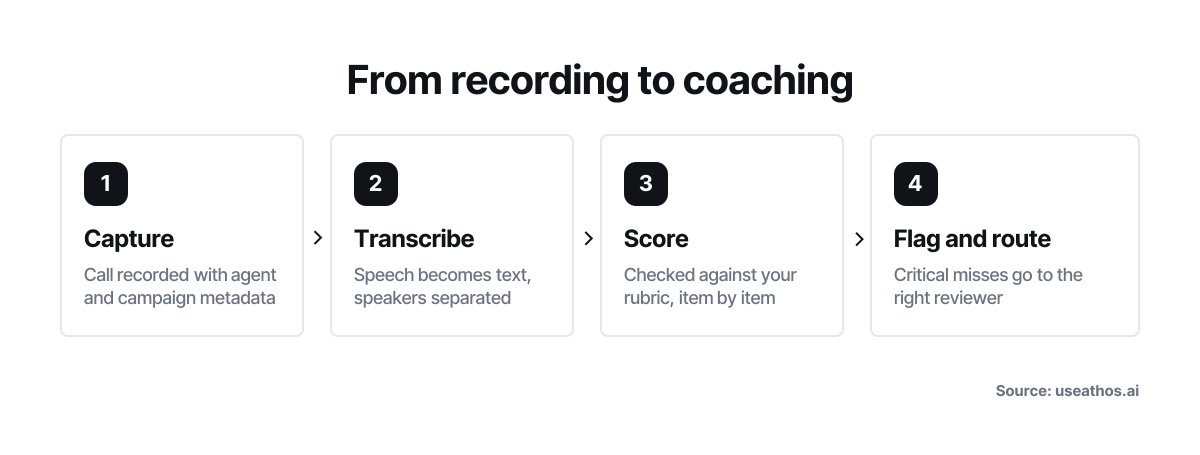
The flow has five stages:
- Capture. The call is recorded in your dialer with its metadata: agent, campaign, disposition, duration.
- Transcribe. Speech becomes text, with speakers separated.
- Score. The transcript is checked against your rubric, item by item.
- Flag. Critical misses and unusual calls get marked for review.
- Route. Each flag goes to the right coach or compliance reviewer with the call moment attached.
You don't listen to a full call to find the problem. You jump to the flagged moment, confirm it, and act.
What automation can't replace
Automation doesn't guarantee compliance. It tells you what happened on a call. It doesn't make the agent say the right thing, and it can't decide what your agency's policy should be.
It also misreads calls. Crosstalk, a poor line or an unusual phrasing can produce a wrong score. That's why a human reviewer should own the rubric and the final call on any serious flag.
Coaching stays human too. The software can show you that an agent skips the same disclosure every Monday. A manager still has to sit down with that agent and fix it. None of this is legal advice, so run your rubric past your own compliance counsel.
What to Score: CMS Compliance, Disclosures and Script Adherence
A scorecard is a list of things you've decided matter. Get it wrong and automation just scales a bad checklist across every call. If you want a deeper look at the engine underneath, see AI call scoring software for insurance call centers.
Scope of Appointment and mandatory disclosures
These are your compliance items. Your compliance lead defines the exact list, but a Medicare Advantage scorecard typically checks:
- SOA obtained and documented before plan discussion
- Required plan-availability and carrier-representation statements delivered
- Recorded-line notice given
- No misleading claims about benefits, networks or carriers
- Enrollment steps completed in the right order
Final Expense calls need different checks. Score whether health questions were read as written, whether benefit terms were stated accurately, and whether the agent stayed within the carrier's script. ACA and Under-65 calls shift again toward eligibility questions, household and income accuracy, and consent.
For the regulatory side, our guide to CMS compliance software for Medicare agents goes further.
Script deviations and coaching opportunities
Not every deviation is a violation. An agent who rephrases a greeting is fine. An agent who rephrases a disclosure is not.
Split the script into two buckets. Locked language must be delivered as written or close to it. Flexible language can change as long as the point lands.
Then score coaching opportunities separately: talk-time balance, objection handling, rapport, how the agent handles a senior who says "I need to talk to my daughter." These don't create risk. They create lost enrollments.
Building a scorecard your QA team trusts
Your reviewers will ignore a score they can't explain. So build the card with them, not around them.
Weight compliance as a gate, not as a share of the total. A call that misses a mandatory disclosure should fail no matter how well the agent built rapport. A call that passes compliance can then be graded on soft skills.
Keep the card short. Every extra line item adds noise and slows calibration. Start with the items that have cost you money before, and add more once the scores prove stable.
How to Set Up Automated Call QA in 6 Steps
Here's the sequence, start to finish:
- Audit current QA. List what gets reviewed today, by whom, and how long findings take to reach agents.
- Connect the dialer. Pull recordings and call metadata into the scoring system.
- Build the rubric. Turn your compliance and sales standards into scorable items.
- Calibrate. Compare automated scores to human reviewers on the same calls.
- Set alerts. Decide what triggers a flag and who receives it.
- Run a weekly coaching loop. Review flags, assign practice, and check repeat errors.
Step one takes an afternoon and pays for itself. You can't improve what you haven't written down.
Connect the dialer and define the rubric
Check which recording formats and metadata your dialer exposes. You need agent ID, campaign, call time and disposition at a minimum, because every later report slices on those fields. Browse the supported dialer integrations to see how the connection works.
Then write the rubric. Start from your existing QA form and your compliance policies. Mark every item as pass/fail or scaled, and mark which are critical fails.
Calibrate scores against human reviewers
This step separates a trusted system from a ignored one. Take a batch of calls your human reviewers have already scored. Run them through the automation and compare item by item.
Where scores disagree, work out why. Sometimes the rubric wording is vague. Sometimes the automation is wrong. Fix the cause, not the score. Repeat until your lead reviewer would sign off on the output.
You own this step. Nobody else knows what "acceptable disclosure delivery" means in your agency.
Set alert thresholds and escalation paths
Too many alerts and your team stops reading them. Too few and you've rebuilt the sample.
Send critical compliance misses to a compliance reviewer fast. Send coaching flags to the agent's manager in a weekly digest. Define who acts, by when, and what happens if nobody does.
Then run step six. Every week, the manager reviews flags, picks one or two patterns per agent, and assigns practice.
Turning QA Scores into Coaching and Faster Ramp
Scoring without coaching is just a report. You've paid to learn what's broken and changed nothing.
Before: a manager hears a few calls, gives general feedback, and the agent keeps making the same mistake until a chargeback proves it. After: the score points to the exact moment, the manager assigns targeted practice, and the next week's calls show whether it worked.
Every repeat error you catch within days is one you don't pay for in weeks.
Closing the loop with AI role-play practice
Live leads are expensive. Using them to teach a new agent how to handle "I'm happy with my current plan" is the costliest practice you can buy.
Move the practice off the dialer. In ATHOS, new agents run full enrollments against unscripted AI senior prospects that throw real Medicare Advantage objections. When QA shows an agent fumbling the same objection, you assign that scenario and check the next batch of calls. Read more on AI role-play training to fix the gaps QA finds.
This also shortens ramp. New agents get feedback on every live call, not just the few that a reviewer happens to hear, and they rehearse fixes before they touch another paid lead.
Using QA data to improve hiring and screening
QA data tells you what your top agents do that your weak agents don't. That's a hiring profile.
Use it to set the bar before you hire. In ATHOS, candidates take a voice-based AI sales simulation first, so managers only interview reps who can sell. Pair that with pre-hire sales assessments built around the objections your own QA flags most.
This won't tell you whether a candidate will stay or whether they'll follow your compliance rules once the pressure is on. It tells you whether they can hold a sales conversation. QA after hire covers the rest.
Dialer Features That Make or Break QA Automation
Most dialers are built for outreach volume, not for QA. Emitrr's guide to auto dialers for insurance agents shows the typical bundle: texting, CRM sync, and 500+ integrations, alongside a 98% text open rate. QA, in this category, is usually a separate layer.
Pricing shows the same pattern. Per-user plans in the category run from $19.99 (Essentials) to $34.99 (Premium) per user per month. The dialer itself is cheap. A batch of unreviewed calls that turns into chargebacks is not.
If you're evaluating a dialer, or checking the one you have, these features matter for QA:
- Recording access. You need full-quality recordings you can export or stream, not just playback in the dialer's own screen.
- Call metadata. Agent, campaign, lead source and disposition let you segment scores and find patterns.
- CRM sync. Scores are more useful next to the enrollment record and the chargeback record.
- Real-time vs post-call scoring. Post-call scoring covers every call and supports coaching. Real-time prompts can help in the moment, but they depend on stable audio and add integration work.
- Integration options. Open APIs or a supported connector save your team from manual exports.
Your dialer doesn't have to change. It does have to let the recordings out.
Measuring Whether QA Automation Is Working
If risk and chargebacks aren't moving, the scores are decoration. Pick the numbers before you launch.
Metrics to track from week one
Baseline your own numbers first. Industry benchmarks won't tell you much about your floor, your carriers or your lead mix.
- Coverage percentage. Share of calls scored. It should sit near 100%.
- Compliance flag rate. Critical flags per 100 calls, by agent and by campaign. Expect it to rise first, because you're finally seeing what was there.
- Time from call to coaching. Days between a flagged call and the conversation with the agent. Shorter is better.
- Repeat-error rate. How often an agent trips the same item after coaching. This is your best measure of whether coaching works.
- Chargebacks. Track them against the weeks when flags were raised and fixed.
- Ramp time. Days until a new agent reaches your production standard.
Review these weekly with your QA lead and sales managers. If a metric stalls, check the rubric and the coaching step before you blame the agents.
Want to see every call on your dialer scored? Book an ATHOS demo and see how it handles your calls.
Frequently asked questions
Does automated call QA guarantee CMS compliance?
No. It shows you what was said on every call, so you find gaps sooner and can coach on them. It can't make an agent say the right thing, and it can misread a bad line. Your compliance lead should own the rubric and review serious flags.
Do I need to replace my dialer to automate QA?
No. You keep your dialer and connect it so recordings and call metadata flow into the scoring system. What matters is that your dialer lets recordings and fields out, through a supported connector or an API.
Can one rubric cover Medicare Advantage, Final Expense and ACA calls?
Not well. The required disclosures, health questions and eligibility checks differ by line. Build a separate scorecard for each, and keep the same structure of critical compliance gates plus weighted sales items.
How do I know the automated scores are accurate?
Calibrate them. Run calls your human reviewers have already scored through the system and compare item by item. When your lead reviewer agrees with the output, the scores are ready for coaching decisions.
Who should own the scorecard?
A human QA or compliance lead. Automation handles coverage and consistency, while a person decides what counts as acceptable, which items are critical fails, and when the rubric needs to change.