
Insurance Sales Readiness Platform: The 2026 Buyer's Guide
Hunter Correll, Co-founder, ATHOS ·

You hire a licensed agent. You hand them paid live leads. Three weeks later you learn they can't close, or worse, they skipped a disclosure on a recorded line.
That is the hiring, ramp and compliance gap an insurance sales readiness platform exists to close. This guide explains what the category is, how it differs from the tools you already pay for, and how to pick one in 2026 without buying a demo.
What an Insurance Sales Readiness Platform Actually Does
An insurance sales readiness platform proves an agent can sell and stay compliant before and after they touch live leads. It tests the skill itself. It does not just track the activity around it.
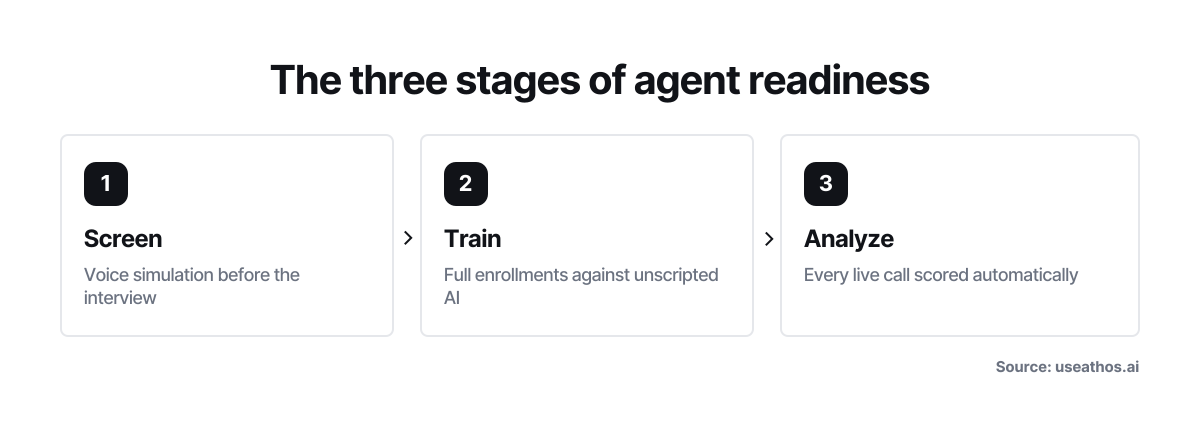
For a phone-based Medicare, Final Expense or ACA team, that means three jobs. It checks candidates before you hire them. It trains new agents without spending lead budget. It reviews live calls after launch, so problems surface in days instead of at audit time.
Readiness vs. CRM, LMS and sales engagement tools
Most agencies already run a CRM, an LMS and a dialer. None of them answers the question you care about: can this person close an enrollment correctly?
- CRM: stores contacts and pipeline. It shows what happened, not how well the agent sold.
- LMS: delivers courses and tracks completion. A finished module says nothing about a live objection.
- Sales engagement platform: sequences outreach and keeps follow-up on schedule.
Sales engagement platforms help build and maintain relationships and improve efficiency, but they sit around the selling skill rather than testing it. A readiness platform fills that gap, and it works alongside the rest of your stack instead of replacing it.
Why Medicare and Final Expense Teams Need Readiness Before Live Leads
Live leads are the most expensive input in your business. Every one handed to an unready agent is a lead you paid for and can't get back.
You feel this twice: once in the lead budget, and again in the weeks a new hire spends figuring out what a seasoned agent already knows.
The cost of burned leads and slow ramp
Traditional ramp looks the same almost everywhere. A new agent reads scripts, shadows a senior rep, then gets leads and learns on real seniors. Shadowing depends on whoever happens to be on the floor that day. Nobody can say whether the new agent can handle "my doctor isn't on that plan" until it happens on a paid call.
Resume-only hiring makes it worse. A license and a good interview tell you almost nothing about how someone sells to a 72-year-old who doesn't want to switch.
The result is a slow ramp, a burned lead pile and managers who spend their week rescuing calls instead of coaching.
Compliance risk: SOA, disclosures and chargebacks
Selling is only half the exposure. The other half is what gets said, and what doesn't, on every enrollment call.
A missing Scope of Appointment, a skipped disclosure or a drifted script can turn into a chargeback, a lost commission or a regulatory problem. Most teams catch these only through random-sample QA, and sampled review leaves most calls unchecked. Whatever isn't in the sample goes unseen until a carrier or a complaint finds it.
You can read more on CMS compliance software for Medicare agents. The core point is simple, though: if you can only audit a small slice, you are guessing about the rest.
The Three Stages of Readiness: Screen, Train, Analyze
ATHOS was founded by Medicare agency owners Hunter Correll and Jason Paradise, who built the Screen, Train, Analyze platform to fix their own hiring, ramp and compliance problems. The three stages follow the agent from candidate to producing rep, and each replaces something you probably do today.
- Screen replaces resume-only hiring.
- Train replaces shadowing and practicing on paid leads.
- Analyze replaces random call sampling.
Screen: voice-based sales simulations before the interview
Step 1. Candidates take a voice-based AI sales simulation before you hire them. They talk, the AI prospect responds, and the platform scores how they handle the conversation.
You then interview only the reps who can sell. That stops you from spending interview hours, onboarding time and lead budget on people who were never going to close. Our piece on pre-hire sales assessments for insurance agents goes deeper on how this works.
Train: AI role-play against unscripted senior prospects
Step 2. New agents practice full enrollments, start to finish, against unscripted AI senior prospects. The prospects don't follow a script, so the agent can't memorize a path through the call.
They throw the objections your agents hear every day:
- "I already have a plan I like."
- "I need to talk to my daughter first."
- "Is my doctor in your network?"
- "Will my prescriptions still be covered?"
- "Why are you calling me?"
An agent can fail a practice call at no cost, repeat it, and get better before a paid lead ever rings. If you want the detail, see how AI role-play training to ramp agents faster is structured.
Analyze: scoring 100% of live calls for compliance and coaching
Step 3. Every live call from your dialer gets scored automatically. That is 100% of calls, not a random sample.
The scoring flags CMS compliance gaps, missed disclosures, script deviations and coaching opportunities. A QA lead who once listened to a handful of calls per agent per month now opens a ranked list of the calls that need attention. They stop hunting and start fixing.
Here is the contrast in plain terms. With sampling, a missed disclosure on call 40 is invisible unless call 40 was pulled. With full coverage, it is flagged the same week, tied to the agent and the moment in the call. For more on the mechanics, read about AI call scoring for insurance call centers.
Scoring finds the gaps. It does not fix them. Someone still has to coach the agent, and that is why the stages feed each other: Analyze findings go back into Train.
Core Capabilities to Look for in an Insurance Sales Readiness Platform
Not every vendor that says "AI" does the same job. Use this section as your checklist, and hold every demo to it, because a polished interface can hide thin Medicare knowledge underneath.
Realistic simulation and objection handling
The simulation is the whole product at the Screen and Train stages, so test it yourself. Ask for the platform to run a call while you play the agent.
Look for these:
- Unscripted prospects that react to what the agent actually says.
- Real Medicare Advantage objections, not generic sales pushback.
- Full-enrollment practice, not just an opening pitch.
- Scoring that explains why a call went wrong.
If the prospect repeats the same three lines no matter what you say, agents will learn to beat the simulation instead of the senior.
Call compliance scoring and coverage
Ask what the platform scores against, and how many calls it scores. Anything short of every call puts you back in sampling territory with better software.
You want automatic scoring for CMS compliance gaps, missed disclosures and script deviations, with each flag tied to a point in the call so a manager can verify it in seconds. Scoring that gives you only a number and no evidence creates more work for QA, not less.
No tool makes you compliant by itself. It gives your compliance program far more visibility than a sample ever could, and that is its job.
Dialer, CRM and reporting integrations
A readiness platform that lives outside your workflow gets ignored within a month. Check that it pulls calls from your dialer without manual uploads and fits the CRM your agents already use.
Then look at reporting. Can a training manager see ramp by cohort? Can a QA lead filter flags by agent, by disclosure type, by week? Can an owner see both on one screen? If reports require an export and a spreadsheet, adoption will stall.
How to Measure Whether Readiness Is Improving
You can't prove improvement without a starting point. Baseline before you roll out anything.
Use your own numbers. Borrowed industry benchmarks tell you about someone else's agents, lead sources and carriers, and they won't tell you whether your last cohort did better than the one before.
Metrics that matter: ramp time, close rate on first leads, QA coverage, chargebacks
Pull these four from your last two or three hiring cohorts, then track them after rollout.
| Metric | What to record before rollout | What you're looking for |
|---|---|---|
| Ramp time | Days from start date to a producing agent, by cohort | A shorter climb for new cohorts |
| Close rate on first leads | Closes on each agent's first batch of live leads | Fewer burned leads per new hire |
| QA coverage | Share of calls actually reviewed | Coverage moving toward every call |
| Chargebacks | Count and cause, by agent and carrier | Fewer chargebacks tied to missed steps |
Keep the definitions fixed. If "producing" means one thing in January and another in June, your comparison is worthless.
One limit to be honest about: a readiness platform cannot fix a bad lead source, weak carrier appointments or a comp plan that drives agents away. If your numbers are poor for those reasons, this is not the first fix.
A Step-by-Step Rollout Plan for Agencies, FMOs and Call Centers
Rolling out everywhere at once is how good tools die. Start small, prove it with your data, then scale.
Step-by-step: baseline, pilot, expand
- Baseline. You pull the four metrics above and list where hiring, ramp and QA break down today. Note how many calls QA reviews now and which compliance errors cost you most.
- Pilot. Pick one cohort, either new candidates or a fresh class of agents. Run them through Screen and Train, and turn on call scoring for their live calls.
- Tie scoring to coaching. Flags only matter if a manager acts on them. Set a weekly rhythm: review flagged calls, coach the specific gap, and send the agent back to practice it.
- Expand. Compare the pilot cohort against your baseline. If the gap shows up in your own numbers, extend to the next cohorts and teams.
The shape changes slightly by organization. An agency owner usually runs one pilot and can move quickly. An FMO focused on enablement can use the platform to vet and train agents across its downline before they send business to carriers. A carrier team can focus on scoring its own call center's conversations for compliance.
Questions to Ask Before You Buy
Put these to every vendor. Blunt questions get useful answers.
- Is it built for Medicare? Ask to hear the objections the simulation raises and see which CMS items the scoring checks.
- How many calls does it score? The answer you want is every live call, not a sample.
- How is our data handled? Ask who can access call recordings and scores, and where they are stored.
- What does it plug into? Name your dialer and CRM and get a direct yes or no.
- What does the coaching workflow look like? A flag with no path to coaching is just a report.
- What does it not do? Any vendor that can't answer that hasn't thought hard about it.
Treat this as software that supports your compliance program. It does not guarantee compliance, and it is not legal advice. Your compliance lead and your carriers' requirements still set the standard.
If you want to see how Screen, Train and Analyze fit together on a real workflow, see the full ATHOS feature set and request a demo.
Frequently asked questions
Is a sales readiness platform the same as an LMS?
No. An LMS delivers courses and records completion. A readiness platform tests whether an agent can actually handle a live Medicare conversation, and it scores real calls after launch. Many teams keep both.
Does it replace my QA team?
No. Automated scoring reviews every call and flags the ones that need attention. Your QA and compliance people still verify flags, make judgment calls and coach agents, but they spend their time on the calls that matter.
Can it guarantee my agents are CMS compliant?
No software can. A readiness platform gives your compliance program full call coverage and flags gaps such as missed disclosures and script deviations. Your team and your carriers still set and enforce the standard.
Who should start with a pilot instead of a full rollout?
Almost everyone. Run one cohort through the workflow and compare their ramp time, first-lead close rate and QA flags against your own baseline. Expand only when your numbers back it up.
Does it work for Final Expense and ACA teams, or only Medicare Advantage?
ATHOS is built for Medicare agencies, FMOs and carriers, and it also serves Final Expense and ACA/Under-65 sales teams. The same Screen, Train, Analyze workflow applies to phone-based licensed agents on those teams.