
Objection Handling Simulator for Insurance to Stop Burning Leads
Hunter Correll, Co-founder, ATHOS ·

Every new agent has a first hard objection. The only question is whose lead it lands on.
If it lands on a live lead you paid for, you pay twice: once for the lead, and again when the agent fumbles it. That is the real cost of a bad agent hire in miniature. An objection handling simulator for insurance moves that first fumble somewhere cheap.
This guide covers what the training is, which objections to drill, how a session runs, and how to keep every rebuttal inside CMS guardrails. It also covers what to look for in a tool and how to tell whether it's working.
What an Objection Handling Simulator for Insurance Actually Is
It's voice-based AI practice against prospects who don't follow a script. The agent talks. The AI senior pushes back the way real seniors do, and the call branches based on what the agent says.
ATHOS was built on this idea. Its founders, Hunter Correll and Jason Paradise, ran Medicare agencies themselves. They watched new hires learn objections on paid leads, so they built a way to practice full enrollments first.
Simulator vs. roleplay with a manager vs. static scripts
Three methods dominate. Each fails in a different place.
- Static scripts. Agents memorize rebuttals. Then a prospect phrases the objection differently and the script falls apart.
- Manager roleplay. Realistic, but it eats senior time. The manager is also a known voice playing a predictable part, and you can't run it 40 times a week per rep.
- AI simulator. Unlimited attempts, a different prospect each time, and a score after every call.
A simulator doesn't replace your best closer coaching a rep. It handles the repetition so that coaching time goes to what the rep actually got wrong. For the broader program around it, see AI role-play sales training for insurance agents.
The Objections Insurance Agents Must Be Ready For
Objections cluster into families. Train each family, not each sentence, because prospects never repeat the exact wording.
Before you drill any of them, teach agents one distinction. A real objection is a specific concern you can answer. A smokescreen is a vague exit line that hides the real concern.
You can test it fast. Answer the stated concern, then ask whether anything else stands in the way. If the prospect still stalls, it was a smokescreen.
Price and "I need to think about it"
"It costs too much" and "let me think about it" sound different but often share a root. The prospect either doesn't see the value or doesn't trust what they've heard.
A stall like "I need to think about it" usually signals an unresolved trust or clarity issue. So the agent should isolate the real concern before rebutting anything. Rebutting a stall head-on just gives the prospect something to push against.
Existing coverage, distrust and plan-complexity objections
These three travel together on older prospects.
- "I already have coverage." The agent's job is to understand it, not attack it.
- "I don't trust phone calls." Seniors get scam calls daily. Calm pacing and a clear explanation of who you are beat any clever line.
- "This is too confusing." The prospect is telling you the agent talked too fast or used too much jargon.
Confusion is the one agents misread most. They keep explaining, and the prospect keeps retreating.
Medicare-specific objections: doctor networks, drug lists, "my current plan is fine"
Medicare Advantage adds its own set. Prospects ask whether their doctor is in network. They ask whether their medications are covered. They say their current plan is fine.
Each of these is a discovery problem. The agent who asked about doctors and prescriptions early has a calm answer ready. The agent who skipped discovery gets ambushed at the close.
Handling these means helping the prospect check their own doctors and drugs against the plan's materials. It never means telling a senior which plan to pick, and a simulator shouldn't teach that.
How a Realistic Objection Simulation Works, Step by Step
A session follows the same five steps every time.
- Scenario setup. Pick the prospect profile and the objection family. A Medicare Advantage enrollment, a Final Expense call and an ACA call each need different setups.
- Live voice conversation. The agent talks out loud to an AI senior prospect, start to finish. No multiple choice, no typing.
- Scoring. The call is graded on rapport, discovery, objection response and close.
- Replay. The agent and manager review the call and see where the exchange turned.
- Retry. The agent runs the same scenario again, or a variation, and compares scores.
Short loop. Fast feedback. No lead burned.
Unscripted prospects and branching conversations
Scripted prospects teach agents to wait for their cue. Real prospects interrupt, change topic and circle back.
An unscripted AI prospect does the same. Say something vague about the doctor question and the prospect pushes on it. Rush the close and the prospect stalls. The conversation branches on the agent's actual words, so memorized lines stop working and listening starts.
That's the point of running full enrollments rather than isolated rebuttal drills. Objections don't arrive alone in real calls. They show up mid-discovery, mid-disclosure and right at the close.
Instant scoring and feedback on every attempt
Feedback delayed by a week teaches nothing, because the rep has forgotten the call. Scoring right after the attempt ties the result to what the agent just said.
The four scoring areas also tell you where to coach. A rep with strong rapport and weak discovery needs different help than a rep who discovers well and flinches at the close. You see that pattern across attempts instead of guessing from one call.
Repetition: why reps need dozens of reps, not one session
One training session builds familiarity. It doesn't build reflexes.
Objection handling is a spoken skill, and spoken skills come from repetition under mild pressure. An agent who has heard "my doctor isn't on that list" dozens of times in practice answers it without freezing. An agent who sat through one workshop freezes on the first live lead.
This doesn't work for agents who won't practice. A simulator gives a willing rep unlimited attempts, but it can't make anyone use them. Managers still need to schedule the reps and review the scores.
You can also run the same simulation before hiring. See how pre-hire sales assessments let you interview only candidates who can actually sell.
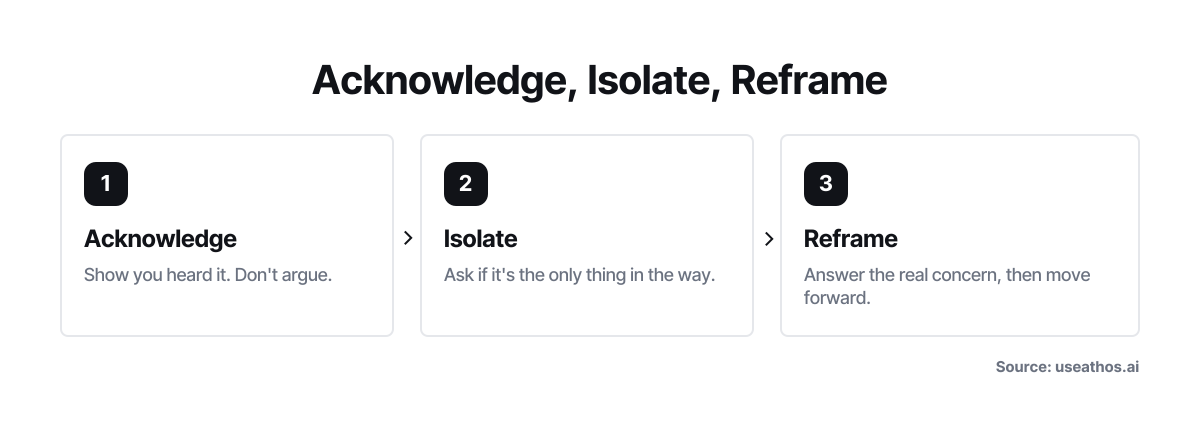
An Objection Handling Framework Agents Can Drill: Acknowledge, Isolate, Reframe
Agents remember three words better than a twelve-step rebuttal tree. Acknowledge, Isolate, Reframe works on most objection families, and it's easy to score.
- Acknowledge. Show you heard it. Don't argue.
- Isolate. Ask whether this is the only thing standing in the way.
- Reframe. Answer the real concern, then move forward.
The reframe carries the compliance risk. It must stay within CMS rules and never promise outcomes like guaranteed savings or guaranteed coverage. Drill it to describe, not to pressure.
Worked example: a price objection
A typical price objection sounds like this:
Prospect: "That premium is more than I want to pay." Agent (acknowledge): "That's fair. Cost matters, and I'd rather you hear it now than later." Agent (isolate): "If the cost question were settled, is there anything else you'd still want to look at?" Prospect: "Well, I just want to be sure my prescriptions are covered." Agent (reframe): "Good, that's worth checking first. Let's go through your medications against the plan's drug list together."
Notice what happened. The objection was never really price. Isolating it surfaced a drug-list concern the agent could answer with facts.
The agent also didn't promise a lower bill or say the plan was the right one. That's the line to hold.
Worked example: "I need to talk to my spouse" or "let me think"
Here the stall is the objection.
Prospect: "I need to talk to my spouse first." Agent (acknowledge): "Makes sense. It's a decision you should both feel good about." Agent (isolate): "What do you think your spouse will want to know? I'd like to make sure you have those answers." Prospect: "Honestly, I'm not sure the doctors are covered." Agent (reframe): "Let's check that now so you're not going back with open questions."
If the prospect truly needs a spouse on the line, the agent offers a time to call back with both present. Either way the agent never pushes past a real request to wait. Under pressure, that's the habit reps fall into, and it leads straight to the next section.
Keeping Objection Handling Compliant: SOA, Disclosures and CMS Guardrails
Objections are where compliance slips. An agent who feels a sale slipping rushes, and rushed agents skip steps.
Nothing here is legal advice, and no tool guarantees compliance. What a simulator can do is make agents practice the required steps under pressure, so those steps are habit before a live call.
Where aggressive rebuttals create compliance risk
Watch for these patterns. They tend to appear when an agent is chasing a close:
- Skipping or rushing a required disclosure to keep momentum.
- Moving into plan details before the SOA is handled properly.
- Making a claim about benefits, savings or coverage that the plan materials don't support.
- Talking over a prospect who asked to slow down.
Each one costs you downstream. A bad enrollment can turn into a chargeback, a lost commission or a regulatory problem you find out about weeks later.
Your agents will handle objections under pressure either way. The only choice is whether they first practice doing it correctly.
Scoring simulations for missed disclosures and script deviations
The same compliance criteria should apply in practice and on live calls. If simulation scores reward a smooth close but ignore disclosures, you're training agents to skip them.
ATHOS scores new-agent simulations and then scores live dialer calls for CMS compliance gaps, missed disclosures, script deviations and coaching opportunities. That means the habit built in practice gets checked in production. Read more on scoring Medicare Advantage dialer calls for compliance.
Manual QA usually reviews a random sample of calls. Automatic scoring covers 100% of calls. The violation that a sample misses is exactly the one that becomes a chargeback.
What to Look for in an Objection Handling Simulator
Most tools claim to offer "AI roleplay." Check the product against this list before you buy, and use the insurance agent training platform checklist for the full evaluation.
- Voice-based. Phone sales are won on tone, pacing and listening. Text chat doesn't test any of that.
- Unscripted. If the prospect follows a fixed path, reps will learn the path.
- Line-specific objections. Medicare Advantage, Final Expense and ACA/Under-65 calls raise different concerns. Generic sales scenarios won't prepare your reps.
- A scoring rubric tied to compliance. Rapport and close scores alone aren't enough. The rubric should flag missed disclosures and script deviations.
- Manager visibility. You should see attempts, scores and trends per rep without listening to every recording.
- A path to live-call QA. Practice scores and live-call scores should use the same criteria.
One limit to keep in mind: a simulator trains and measures behavior in practice. It doesn't replace your compliance program, and it won't fix a weak script or a bad lead source.
Measuring Whether Simulation Training Is Working
Don't trust a generic benchmark. Your own baseline is the only number that matters.
Before rollout, record how your team performs today. After rollout, compare the same measures on the same kind of agent.
Ramp time, burned leads and chargebacks as the scorecard
Track four measures, before and after:
- Time to first sale. How long from licensing or start date to the first enrollment.
- Close rate on first live leads. This shows whether new agents are wasting expensive leads.
- Chargebacks. Early ones often point to enrollments that shouldn't have happened.
- Compliance flags. Count missed disclosures and script deviations per agent.
If simulation is working, new agents reach first sale sooner and the first live leads convert better. Chargebacks and flags should fall. To dig into the ramp side, see how to cut ramp time in Medicare Advantage sales.
If scores rise in the simulator but nothing moves on live calls, your scenarios are too easy. Make them harder.
Closing the loop with live-call scoring
Live calls are your best source of new scenarios. When call scoring shows a pattern, say reps losing prospects at a specific drug-list question, build that situation into the simulator.
Then retest. The simulator trains the fix, and live scoring confirms whether it held. From there, AI agent coaching software turns those results into ongoing coaching.
Want to see how this would run on your own agents and objections? Explore the Train step at ATHOS and put an AI prospect in front of your newest rep.
Frequently asked questions
How is an AI objection simulator different from a manager roleplay?
A simulator runs without a manager's time, so reps can practice as often as they like. The AI prospect is unscripted and different each run, and every attempt is scored right away. Manager roleplay still helps for coaching, but it can't give each rep dozens of repetitions.
How do I tell a real objection from a smokescreen?
Answer the stated concern, then ask whether anything else stands in the way. A real objection goes away once it's answered. If the prospect still stalls, the stated concern was a smokescreen, and the agent needs to isolate what's really holding them back.
Can a simulator guarantee my agents stay compliant?
No. It lets agents practice SOA steps and required disclosures under pressure, and it scores the same criteria you use on live calls. It doesn't replace your compliance program or legal review.
Does simulation training work for Final Expense and ACA teams?
Yes, if the tool uses scenarios for your line. Final Expense and ACA/Under-65 calls raise different objections than Medicare Advantage, so generic sales scenarios won't prepare your reps.
What should I measure to know the training is working?
Track time to first sale, close rate on first live leads, chargebacks and compliance flags. Compare them against your own numbers from before rollout. If simulator scores rise but live results don't, make the scenarios harder.